
Concentric infill creates parallel loops that form circular patterns inside your 3D prints, making it perfect for cylindrical and round objects. You’ll get enhanced structural integrity as the pattern mirrors your object’s contours and distributes stress evenly. This infill type improves surface finish quality with seamless coverage and reduces defects on curved surfaces. It’s ideal for vases, lamp shades, and decorative pieces where aesthetics matter. Continue exploring to discover ideal density settings and troubleshooting techniques.
Understanding Concentric Infill Pattern Mechanics

When you choose concentric infill for your 3D prints, you’re selecting a pattern that creates parallel loops forming concentric circles throughout the interior structure.
This pattern follows your model’s contour, making it particularly effective for cylindrical and round objects where aesthetic appeal matters most.
You’ll notice that concentric circles provide excellent visual results, especially with transparent materials where the internal structure becomes visible.
However, you must consider its mechanical properties carefully. The pattern offers reduced load-bearing capacity compared to traditional grid patterns, making it unsuitable for parts experiencing horizontal stress.
Concentric infill’s reduced load-bearing strength makes it inappropriate for components that will experience significant horizontal stress during use.
Your material usage and print time will increase with higher densities, but this trade-off delivers improved structural strength when you need both form and function.
Advantages of Concentric Infill for Cylindrical Objects
When you’re printing cylindrical objects, concentric infill offers distinct advantages that align perfectly with your design’s geometry.
You’ll notice enhanced structural integrity as the circular pattern follows the natural stress distribution of round shapes, preventing weak points that occur with linear infill patterns.
The concentric layers also deliver an improved surface finish, especially when you’re using transparent materials where the infill pattern becomes part of the visual appeal.
Enhanced Structural Integrity
While traditional infill patterns often struggle to complement the geometry of round objects, concentric infill creates concentric circles that mirror your cylindrical print’s natural contours. This alignment dramatically enhances your print’s structural integrity by distributing stress evenly throughout the entire structure.
You’ll notice improved load-bearing capacity as the concentric pattern works with your object’s geometry rather than against it. The uniform material distribution eliminates weak points that typically occur when linear patterns intersect curved surfaces at awkward angles.
Your cylindrical structures benefit from superior mechanical properties because the concentric layers follow the natural stress lines of round objects. This results in better layer adhesion, reduced delamination risk, and enhanced overall durability that traditional grid patterns simply can’t match.
Improved Surface Finish
Beyond strengthening your cylindrical prints, concentric infill greatly improves surface finish quality by creating seamless coverage patterns that align perfectly with your object’s geometry.
The concentric infill pattern follows your print’s perimeter shapes, providing superior coverage that translates into markedly improved surface finish across your top layers. You’ll notice fewer gaps and inconsistencies compared to traditional grid patterns, as the circular design naturally complements round geometries.
This enhanced coverage considerably reduces surface defects while boosting your print’s aesthetic appeal, especially when using transparent materials where light diffusion creates stunning visual effects.
The uniform strength distribution guarantees smoother top layer appearance, ultimately delivering a polished final product that’s perfect for both decorative items and functional components requiring professional-quality finishes.
When to Choose Concentric Over Other Infill Patterns
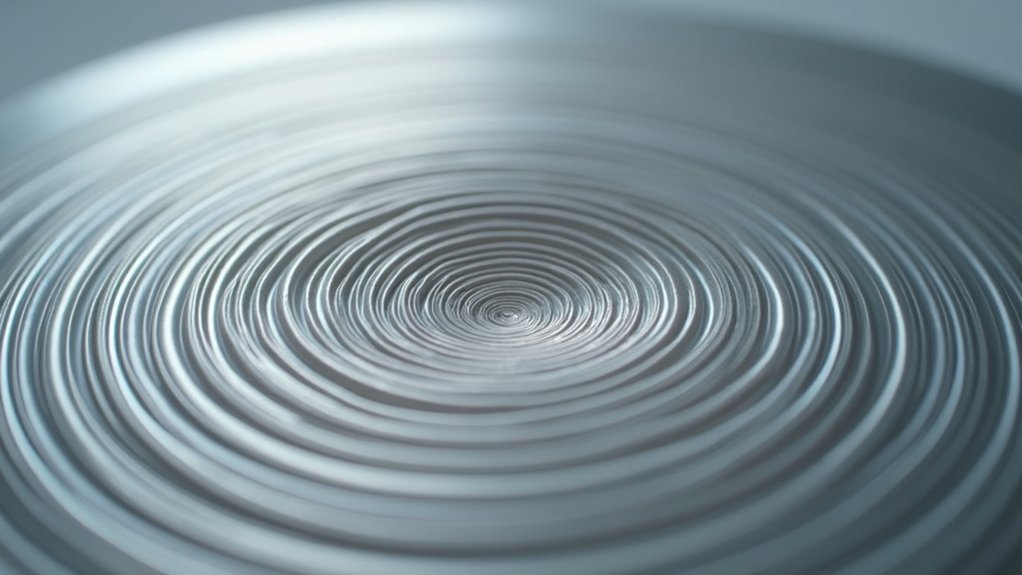
Although most infill patterns prioritize structural strength, you’ll want to choose concentric infill when aesthetics take precedence over load-bearing capacity. This pattern excels for round prints where visual appeal matters most, particularly decorative models and artistic pieces.
You should select concentric infill when creating cylindrical objects that showcase transparent or translucent materials, as the circular layers enhance the overall appearance.
However, avoid concentric infill for functional parts that experience horizontal stress, since it provides limited structural integrity compared to grid or triangular patterns. Instead, reserve this infill for vases, lamp shades, or display models where the circular geometry complements the object’s shape.
Use higher infill densities to maximize coverage and achieve the best aesthetic appeal for your round prints.
Density Settings for Optimal Concentric Infill Performance
You’ll find that concentric infill density directly impacts your print’s strength, speed, and material consumption.
Lower densities under 20% can compromise structural integrity for functional parts, while settings between 20% to 100% offer the sweet spot for balancing performance with efficiency.
Higher densities above 50% maximize strength and durability but increase both print time and filament usage considerably.
Low Density Limitations
When implementing concentric infill at densities below 30%, you’re likely to encounter significant structural weaknesses that compromise your print’s integrity. Low infill density severely reduces load-bearing capacity, making your prints vulnerable to deformation under horizontal stress. While this creates visually appealing concentric patterns, the compromised structural integrity makes it unsuitable for functional parts requiring durability.
| Density Range | Structural Performance | Best Use Case | Risk Level |
|---|---|---|---|
| 10-20% | Poor load-bearing | Decorative only | High print failures |
| 20-30% | Marginal strength | Light-duty parts | Moderate risk |
| 30-50% | Adequate support | General purpose | Low risk |
| 100% | Maximum strength | Critical parts | Minimal risk |
Consider your project’s requirements carefully—aesthetic appeal shouldn’t overshadow the need for reliable performance in demanding applications.
Optimal Density Range
Since concentric infill performs best within the 30-100% density range, you’ll achieve ideal results by selecting your density based on your specific application requirements.
The best density directly impacts your print’s mechanical performance and internal structure quality.
Consider these density guidelines for concentric infill:
- 30-50% density – Perfect for lightweight prints and transparent materials where aesthetics matter
- 50-70% density – Balanced approach offering good strength while managing print time and material consumption
- 70-85% density – Excellent for load-bearing applications requiring enhanced durability
- 85-100% density – Maximum strength for robust cylindrical objects under heavy stress
Higher infill density dramatically improves structural integrity but increases print time and material usage.
You’ll need to balance these factors against your project’s specific strength requirements and budget constraints.
High Density Benefits
At the upper end of this range, high-density concentric infill delivers exceptional performance benefits that make it the preferred choice for demanding applications.
When you set your density at 100%, you’ll achieve maximum strength for functional parts requiring exceptional durability. The concentric pattern distributes material evenly along cylindrical contours, considerably enhancing structural integrity throughout your print.
You’ll notice improved surface coverage that creates smoother top layers and better aesthetic finishes. This high-density approach helps reduce deformation when your prints face horizontal stresses, eliminating weak points that could compromise performance.
Your final products maintain their shape under load, ensuring reliable print performance. The investment in higher material usage pays off through superior mechanical properties and professional-quality results.
Print Quality and Surface Finish Benefits
Although many infill patterns prioritize structural strength, concentric infill excels at creating exceptional surface quality for round prints. This pattern’s unique approach to matching your print’s perimeter shape delivers superior print quality benefits that enhance your project’s overall appearance.
Concentric infill transforms round prints by following perimeter contours, delivering unmatched surface quality over traditional strength-focused patterns.
The concentric pattern improves your surface finish through several key mechanisms:
- Enhanced layer adhesion – Minimizes gaps and inconsistencies on top layers of cylindrical objects
- Improved aesthetic appeal – Creates visually pleasing concentric circles that follow your print’s outer shape
- Better stress distribution – Spreads forces more evenly across the surface by matching infill to perimeter
- Dynamic light interaction – Produces striking visual effects when using transparent materials
While concentric infill excels in print quality, it’s best reserved for decorative models rather than functional parts requiring horizontal stress resistance.
Structural Strength Characteristics of Concentric Infill

While concentric infill delivers impressive aesthetic results, understanding its structural limitations becomes essential when you’re evaluating it for functional applications.
You’ll find that concentric infill’s structural strength differs greatly from other patterns, particularly regarding directional loading. The load-bearing capacity remains considerably weaker in the horizontal direction, making it less suitable for models experiencing horizontal stress.
Additionally, concentric infill provides less effective support for vertical loads compared to grid-based patterns. You can improve strength by increasing infill density, with maximum performance achieved at 100% infill, though this dramatically increases material usage.
Ultimately, concentric infill serves decorative purposes better than structural applications, so consider your project’s functional requirements carefully before choosing this pattern.
Material Usage and Print Time Considerations
Efficiency concerns often arise when selecting concentric infill for your round prints, as this pattern typically consumes more material than alternatives like grid or zigzag patterns.
The overlapping loops characteristic of concentric infill contribute to increased material usage, making it less economical for functional prototypes.
Several factors influence material consumption and print time with concentric infill:
- Infill density directly impacts filament usage – higher densities require more concentric loops
- Print time increases proportionally with the number of required loops
- Material consumption exceeds other patterns due to overlapping circular paths
- Decorative prints may justify the extra cost when aesthetics matter
While concentric infill isn’t the most efficient option for material usage, you might find the visual appeal worth the trade-off for transparent materials or aesthetic applications.
Common Applications for Concentric Infill Pattern
Because concentric infill creates visually striking circular patterns, you’ll find it excels in decorative applications where aesthetics take precedence over structural strength.
This pattern works exceptionally well for vases, artistic sculptures, and other decorative objects where visual quality matters most. You’ll achieve superior results when printing cylindrical shapes, as the concentric pattern naturally follows the model’s perimeter, enhancing surface coverage and aesthetic appeal.
However, you shouldn’t use concentric infill for functional parts requiring high load-bearing capacity, particularly those experiencing horizontal stress.
The pattern’s circular nature provides limited structural support compared to grid-based alternatives. When working with transparent materials, concentric infill truly shines by highlighting its distinctive circular layers, making it perfect for display pieces and artistic creations.
Troubleshooting Concentric Infill Print Issues
Although concentric infill creates stunning visual effects, you’ll encounter specific printing challenges that require targeted solutions.
The key issues you’ll face with concentric infill include:
- Poor load-bearing capacity – This pattern struggles with horizontal stress, making it unsuitable for parts requiring significant structural integrity in that direction.
- Print failures from incorrect infill density – Too low creates gaps while excessive density wastes material and time without proportional strength gains.
- First layer adhesion problems – Concentric infill depends heavily on well-calibrated initial layers for maintaining overall print quality.
- Uneven extrusion issues – Nozzle clogs or material inconsistencies disrupt the circular patterns, creating weak spots and visual defects.
Monitor your printer’s performance closely and adjust settings based on your specific project requirements to achieve ideal results.
Frequently Asked Questions
What Does Concentric Mean in 3D Printing?
In 3D printing, you’ll find concentric refers to an infill pattern that creates circular paths following your model’s shape. You’re creating concentric rings that work especially well for cylindrical objects and decorative prints.
What Is the Most Efficient Infill Pattern?
You’ll find zig zag is typically the most efficient infill pattern since it allows continuous extrusion without retractions. Rectilinear and cubic patterns also offer excellent efficiency by balancing print speed with material usage.
What Is the Difference Between 80% and 100% Infill?
You’ll get maximum strength and weight with 100% infill but longer print times and more material usage. 80% infill offers lighter weight, faster printing, and lower costs while maintaining adequate structural support.
Is 40% Infill Too Much?
You’ll find 40% infill isn’t too much for structural prints needing strength, but it’s excessive for decorative items. You’re balancing material usage with durability, though it’ll increase print time considerably.

Leave a Reply