
You’ll find gyroid infill stronger because it’s a triply periodic minimal surface with interconnected curved channels that distribute stress uniformly in all directions. Unlike traditional patterns with directional weaknesses, gyroid’s continuous lattice structure eliminates stress concentration points and maintains structural integrity even at low densities like 10-15%. Its zero mean curvature and multi-directional force dispersion create isotropic strength, delivering superior performance from every angle while using less material than conventional infill patterns require for similar strength levels.
Understanding Gyroid’s Unique Geometric Structure
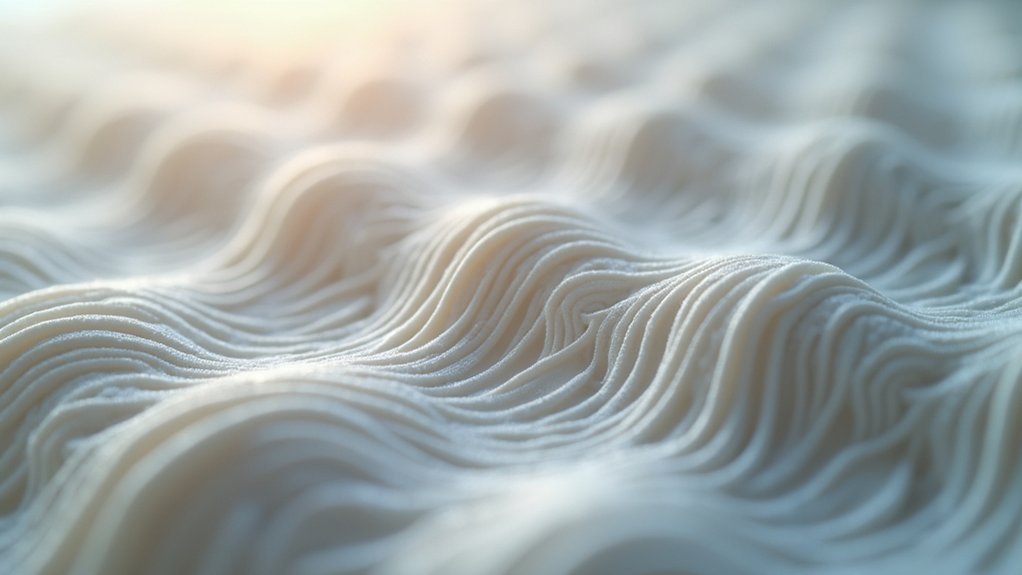
When you examine gyroid infill under a microscope, you’ll discover a fascinating triply periodic minimal surface that resembles an intricate maze of interconnected channels.
This gyroid structure creates interlocking networks that distribute stress uniformly throughout your printed object, eliminating the weak points found in traditional patterns.
What makes this structure truly remarkable is its chirality – an inherent asymmetry that prevents structural vulnerabilities.
Unlike grid or rectilinear patterns that favor specific directions, gyroid’s unique geometry delivers isotropic strength, meaning you’ll get consistent performance from all angles.
Unlike simple patterns that create directional weaknesses, gyroid infill delivers uniform strength from every angle through its sophisticated geometric architecture.
The absence of straight lines creates a flexible yet robust internal framework that’s perfect for mechanical components requiring multi-directional strength.
This sophisticated architecture explains why gyroid consistently outperforms simpler infill patterns in demanding applications.
Stress Distribution and Load-Bearing Capabilities
Because gyroid’s continuous lattice structure distributes mechanical stress across multiple pathways simultaneously, your printed parts can handle loads from any direction without developing the weak points that plague conventional infill patterns.
The interlocking lattice structure’s minimal surface geometry creates exceptional load-bearing capabilities through several key advantages:
- Zero mean curvature eliminates stress concentrations that typically cause failure points
- Triply periodic design maintains structural integrity even at low infill density levels
- Multi-directional force dispersion enhances durability under complex loading conditions
- Optimized material usage achieves superior strength-to-weight ratio compared to traditional patterns
You’ll find that gyroid infill maintains its load-bearing performance even at densities as low as 10%, making it ideal when you need maximum strength with minimal material consumption for your stress distribution requirements.
Comparative Analysis With Traditional Infill Patterns

Most traditional infill patterns fall short when you compare their directional limitations against gyroid’s omnidirectional strength capabilities. Grid and rectilinear patterns create weak points at linear intersections, while gyroid’s interlocking lattice distributes loads efficiently across all directions. You’ll achieve superior structural strength with less material usage since gyroid maintains mechanical properties even at 10% density, unlike traditional patterns requiring higher densities for comparable performance.
| Aspect | Traditional Patterns | Gyroid Infill |
|---|---|---|
| Load Distribution | Directional weakness | Omnidirectional strength |
| Efficiency | High material usage | 10x strength-to-weight ratio |
| Print Times | Longer for same strength | Faster due to continuous curves |
| Weak Points | Linear intersection failures | Maintains integrity at low density |
You’ll notice gyroid’s superior efficiency eliminates the trade-offs between print times and strength that plague conventional infill methods.
Impact of Infill Density on Structural Performance
Understanding how infill density affects structural performance becomes essential when you’re refining prints for specific applications. Higher infill density delivers increased strength but requires more material usage and extended print times.
Higher infill density increases structural strength but demands more material and longer print times for optimal performance.
Gyroid infill’s interlocking geometry maintains exceptional structural performance even at lower infill percentages, demonstrating superior load distribution compared to traditional patterns.
Consider these key density guidelines for optimal results:
- 10-15% density: Gyroid infill maintains impressive shear strength while maximizing material efficiency
- 15-25% density: Ideal range for functional prints requiring balanced strength and cost-effectiveness
- 25-40% density: Enhanced support capabilities without creating solid interiors
- Above 40% density: Maximum structural performance for demanding applications
Gyroid infill’s unique three-dimensional structure guarantees consistent strength in all directions, making it considerably more effective than conventional patterns that often excel in only specific orientations.
Real-World Testing Results and Strength Measurements

Laboratory testing validates gyroid infill’s theoretical advantages through rigorous mechanical analysis and real-world performance evaluations.
When you examine real-world tests, you’ll discover that gyroid infill achieves strength levels up to 10 times greater than steel while maintaining only 5% density using advanced materials like graphene.
Your mechanical testing reveals superior deformation resistance compared to traditional patterns such as grid or honeycomb structures.
Studies show you’ll maintain structural integrity even at densities as low as 10%, with gyroid’s interconnected channels providing exceptional load distribution.
This creates an isotropic strength profile that guarantees even stress distribution throughout your print, enabling components to withstand both vertical and horizontal forces more effectively than conventional infill geometries.
Frequently Asked Questions
Why Is Gyroid the Best Infill Pattern?
You’ll find gyroid infill delivers superior strength-to-weight ratios through its interlocking lattice structure. It distributes stress evenly in all directions, prevents warping, maintains integrity at low densities, and dissipates heat effectively.
Which Is the Strongest Infill Pattern?
You’ll find gyroid infill is the strongest pattern available. Its triply periodic minimal surface structure distributes loads evenly in all directions, achieving exceptional strength-to-weight ratios that surpass traditional patterns.
Is Gyroid Infill Stronger Than Honeycomb?
Yes, gyroid infill’s stronger than honeycomb because you’ll get multidirectional strength distribution instead of single-direction reinforcement. You’ll achieve better strength-to-weight ratios and maintain structural integrity at lower infill densities.
What Are the Disadvantages of Gyroid Infill?
You’ll face longer slicing and print times due to gyroid’s complex geometry. You can’t easily customize internal features, and you’ll get reduced transparency. The intricate structure limits your control over specific functional requirements.