
Getting your 3D printing filament certified as food safe requires maneuvering through FDA regulations under CFR Title 21 Parts 174-179 and EU Regulation (EC) No 1935/2004. You’ll need to submit technical datasheets, manufacturing records, and migration testing results proving your material doesn’t release harmful substances. Choose proven materials like PETG or certified nylon formulations, then work with accredited testing laboratories to verify compliance. The certification process involves extensive documentation, but understanding each requirement will streamline your path to approval.
Understanding Regulatory Frameworks and Compliance Standards
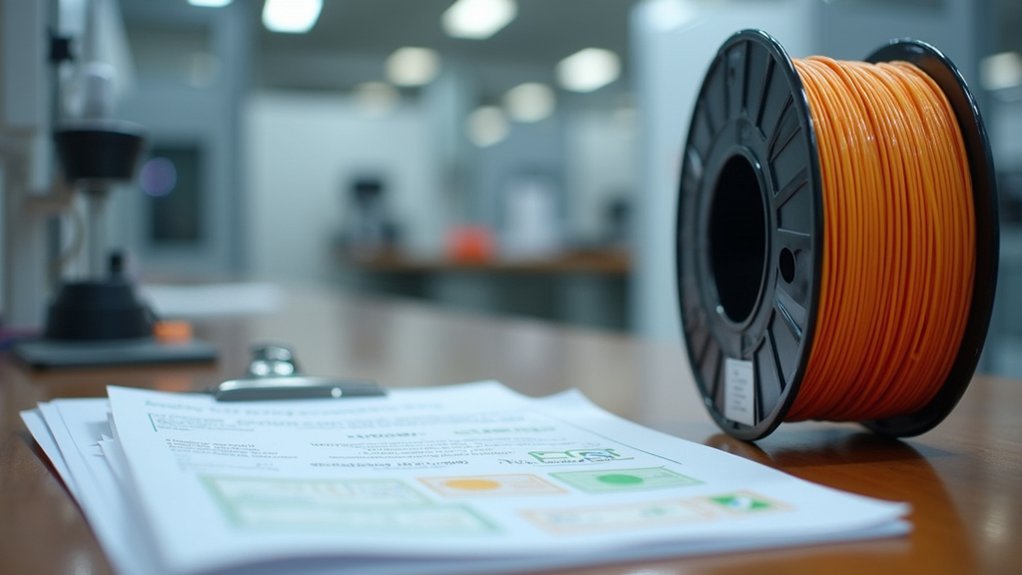
Before you can successfully obtain food safe filament certification, you’ll need to navigate complex regulatory frameworks that vary considerably between regions.
In the United States, you must comply with FDA’s Federal Food, Drug, and Cosmetic Act, which covers all material components that might migrate into food—not just the base polymer. Your filament falls under Food Contact Substances regulations in CFR Title 21, Parts 174-179, particularly Part 177 for polymers.
You can pursue approval through GRAS recognition, prior sanctioned substances, Threshold of Regulation exemptions for minimal migration, or Food Contact Substance Notifications for new materials.
In Europe, you’ll work under Regulation (EC) No 1935/2004, which prohibits releasing harmful substances or altering food properties. You must differentiate between short-term and long-term contact scenarios when determining acceptable migration limits. Additionally, EU guidelines 10/2011 provide specific safety standards that complement the broader regulatory framework for food contact materials.
Selecting Certified Food Safe Filament Materials
Selecting the right material forms the foundation of your food safe filament certification journey.
You’ll need to choose materials that inherently meet regulatory standards while considering your application’s specific requirements.
Start with these proven food-safe materials:
- PETG – Widely used for food contact applications with excellent clarity and chemical resistance
- Nylon PA12 – Offers superior durability for food processing tools, though verify specific formulations
- Titanium – Provides exceptional strength and corrosion resistance for demanding applications
- Aluminum – When properly treated or coated, delivers thermal conductivity and structural integrity
Remember that base materials aren’t enough.
You must verify that additives, colorants, and processing aids comply with FDA or EU regulations.
Generic “food-safe” labels won’t suffice—demand specific compliance documentation from manufacturers. Manufacturers must provide technical datasheets referencing relevant CFR titles to demonstrate proper regulatory compliance.
Documentation and Testing Requirements for Certification
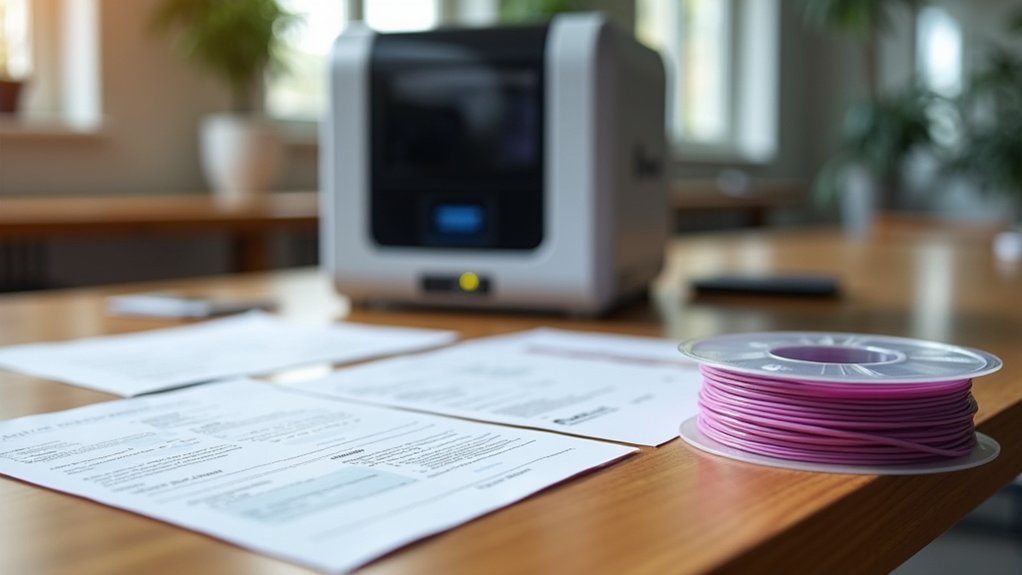
The certification process demands rigorous documentation that proves your filament meets specific regulatory standards rather than relying on manufacturers’ generic claims. You’ll need thorough technical datasheets referencing specific CFR titles or EU regulations, not generic “food grade” labels.
| Documentation Type | Required Information |
|---|---|
| Technical Datasheets | Specific CFR/EU regulation references |
| Manufacturing Records | Quality controls and component traceability |
| Testing Results | Migration levels meeting regulatory thresholds |
Your documentation must include detailed information about raw materials, additives, residual monomers, and processing aids that could migrate into food. You’ll also need migration testing results following recognized standards, plus evidence of overall and specific migration limits. Records of manufacturing processes and quality controls are essential for supporting your certification file. Additionally, you should maintain a dedicated printer for food-safe production to prevent cross-contamination from non-food-grade materials that could compromise your certification status.
Post-Processing and Surface Treatment for Food Safety
Even when your filament meets food safety standards, raw 3D prints from FDM printers aren’t ready for direct food contact.
Layer gaps and micro-porosities harbor bacteria, making surface sealing essential for food safety compliance.
Before applying any coating, you’ll need to thoroughly clean your prints with mild soap and warm water, remove all support structures, and guarantee complete drying.
Sand rough surfaces to improve coating adhesion and eliminate imperfections where bacteria could hide.
Choose from several food-safe coating options:
- Epoxy resins – Certified for food contact with excellent chemical resistance
- Silicone coatings – Flexible, waterproof sealing ideal for molds and utensils
- Food-grade varnishes – Light sealing option that may require frequent reapplication
- Specialized spray coatings – Thin, uniform coverage reducing bacterial adhesion
Apply multiple layers following manufacturer curing instructions for ideal protection.
Remember that printer settings like temperature and pressure can degrade filament quality, affecting the safety of your final printed object.
Commercial Production and Quality Control Protocols
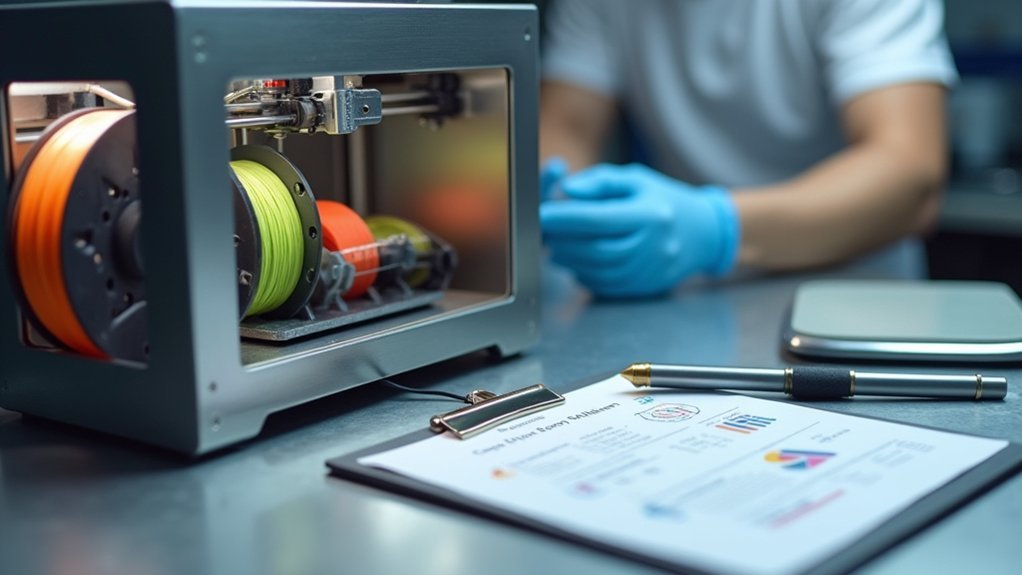
When scaling up from prototype to commercial production, you’ll need robust quality control protocols that guarantee every food-safe filament batch meets regulatory standards. Establish dedicated production lines using exclusive equipment to prevent cross-contamination from non-certified materials. Document all manufacturing parameters, including temperature controls and environmental conditions, as part of your quality management system.
| Quality Control Area | Testing Frequency | Documentation Required |
|---|---|---|
| Raw Material Inspection | Every batch | Supplier certificates, migration testing |
| Production Environment | Daily | Temperature logs, cleanliness records |
| Filament Properties | Per production run | Mechanical testing, chemical analysis |
| Equipment Calibration | Weekly | Maintenance logs, calibration certificates |
| Final Product Verification | Random sampling | Compliance testing, batch traceability |
Implement rigorous sampling protocols and maintain detailed records for regulatory audits and certification renewals. Only a few manufacturers complete the certification process, making certified materials more expensive but essential for businesses prioritizing regulatory compliance.
Frequently Asked Questions
How Much Does Food Safe Filament Certification Typically Cost?
You’ll face high testing and certification costs that vary by certification body and material type. Certified food-safe filaments cost more than non-certified ones due to rigorous compliance processes and ongoing monitoring requirements.
How Long Does the Certification Process Usually Take?
You’ll typically wait several months to over a year for certification completion. The timeline depends on your submission’s complexity, completeness, and which pathway you’re pursuing—GRAS, FCN, or TOR applications.
Can I Use My Home 3D Printer for Food Safe Applications?
You can use your home 3D printer, but you’ll risk cross-contamination from other materials. It’s recommended you dedicate a printer exclusively for food applications and apply proper surface coatings.
Do I Need Separate Certifications for Different Colors of the Same Filament?
You’ll likely need separate certifications for different colors since colorants can affect regulatory compliance. Each color variant requires individual testing and documentation to guarantee the additives don’t compromise food safety standards.
What Happens if My Certified Filament Fails During Recertification Testing?
You’ll lose your regulatory compliance status and must stop marketing as food-safe. You’ll need corrective actions like reformulation, notify customers immediately, and potentially face product recalls until recertification succeeds.
In Summary
You’ve now got the roadmap to achieve food safe filament certification. Remember, you’ll need to navigate complex regulations, choose appropriate materials, maintain thorough documentation, implement proper post-processing techniques, and establish robust quality controls. Don’t cut corners on testing or compliance – your certification depends on meeting every standard. Stay current with evolving regulations and maintain consistent protocols throughout your production process to guarantee ongoing certification success.