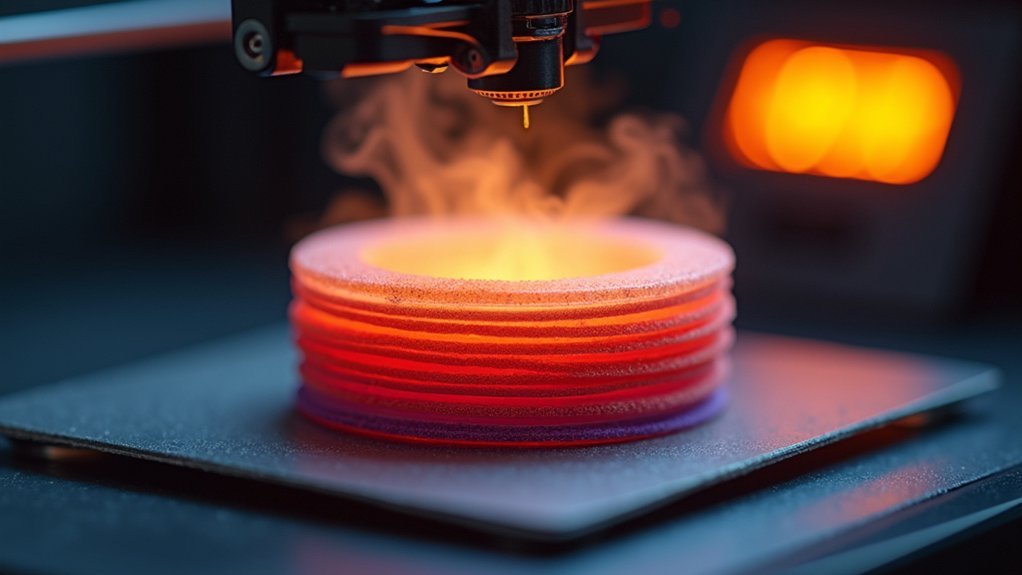
You’ll achieve dramatically stronger layer adhesion by maintaining consistent temperatures inside an enclosed printing chamber. When you control the thermal environment, you prevent rapid cooling that creates weak bonds between layers. Enclosures can boost layer adhesion strength by nearly 50% – for example, ABS samples jump from 21 MPa in open air to 29 MPa with active heating at 65°C. The controlled environment allows polymer chains to bond properly before cooling, eliminating thermal stress and warping that compromises your print’s structural integrity.
Understanding Layer Adhesion in 3D Printing
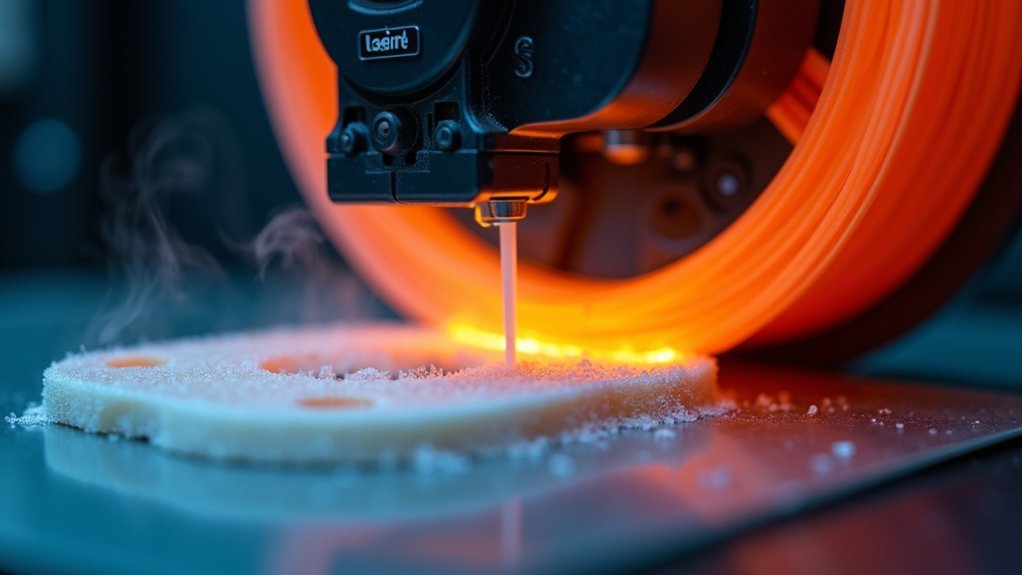
While achieving stunning visual results often captures attention in 3D printing, layer adhesion forms the backbone of every successful print’s structural integrity. When layers don’t bond properly, you’ll notice visible separation, cracks, or splits that compromise your object’s durability.
Several factors directly impact layer adhesion quality. Incorrect printing temperature prevents proper material flow and bonding between successive layers. Your heated bed helps with first-layer adhesion, but upper layers still face challenges.
Related guide: Best 3D Printer Enclosures for Better Print Quality and Temperature Control
Environmental factors like rapid cooling create thermal stress, leading to warping and weak interlayer bonds. Poor layer height settings compound these issues by affecting material deposition.
An enclosure addresses many environmental factors by maintaining consistent temperatures throughout your print, reducing thermal shock that weakens layer adhesion and overall structural integrity.
The Science Behind Enclosure Temperature Control
Enclosures work by creating a controlled thermal environment that fundamentally changes how your printed layers cool and bond together.
By maintaining stable ambient temperature, you’ll prevent rapid cooling that causes warping and poor adhesion in materials like ABS and Nylon.
The science is straightforward: when your enclosure keeps printed parts warmer longer, materials stay softer and allow better material reorientation between layers.
Actively heated enclosures achieve temperatures up to 65°C, dramatically improving layer adhesion strength.
Heated enclosures reaching 65°C create optimal thermal conditions that significantly boost layer bonding performance in demanding materials.
This controlled cooling reduces thermal contraction that leads to layer separation.
Testing proves the effectiveness – ABS samples reach 29 MPa adhesion strength in heated chambers, nearly 50% stronger than open-air prints.
Your enclosure fundamentally eliminates the temperature fluctuations that compromise structural integrity.
How Heat Affects Filament Bonding Properties

When you heat filament during printing, you’re fundamentally changing how polymer chains move and interact at the molecular level.
Higher temperatures reduce your material’s viscosity, making it flow more readily and bond more effectively with previous layers.
The rate at which these heated layers cool determines whether you’ll achieve strong molecular entanglement or weak, brittle interfaces between your print layers.
Thermal Polymer Chain Mobility
As temperatures rise within an enclosed printing environment, polymer chains gain increased mobility that directly impacts how well your filament layers bond together.
When you maintain elevated temperatures around 65°C, you’re reducing thermal contraction that typically occurs during cooling, keeping your filament softer and more pliable for longer periods.
This enhanced mobility allows polymer chains to achieve better alignment and fusion between layers.
In actively heated environments, you’ll prevent the abrupt cooling that causes poor layer adhesion and separation.
Research shows materials like ABS and Prusament PCBlend demonstrate up to 50% greater strength when printed at ideal printing temperatures compared to open-air conditions.
The consistent thermal conditions you create enable superior interlayer bonding, resulting in stronger, more durable prints.
Temperature-Dependent Viscosity Changes
Because heat fundamentally alters how your filament flows during extrusion, understanding viscosity changes becomes essential for achieving ideal layer bonding. Temperature-dependent viscosity changes directly impact how well molten material fuses with previously deposited layers. When elevated temperatures reduce your thermoplastic’s viscosity, you’ll get smoother flow that enhances filament bonding between successive layers.
| Temperature Range | ABS Strength | Layer Quality |
|---|---|---|
| Room Temperature | 21 MPa | Poor adhesion |
| 45°C Chamber | 25 MPa | Improved |
| 65°C Chamber | 29 MPa | Excellent |
| 80°C+ | Variable | Risk of sagging |
| Uncontrolled | 18-23 MPa | Inconsistent |
Your heated chamber maintains optimal viscosity throughout printing, promoting superior interlayer adhesion while minimizing thermal contraction that causes delamination.
Cooling Rate Effects
While viscosity changes establish the foundation for proper flow, controlling your filament’s cooling rate determines whether that improved flow translates into durable layer bonds.
Your enclosure’s stable temperatures prevent rapid cooling that weakens filament bonding at the molecular level. When you maintain slower cooling rates, you’re giving polymer chains more time to interlock properly between layers, creating stronger adhesion.
The cooling rate directly impacts your print’s structural integrity. In controlled environments, slower cooling greatly reduces delamination risks and produces stronger inter-layer bonds.
Your ideal thermal management strategy should focus on heat retention rather than quick cooling. By preventing temperature fluctuations, you’re ensuring consistent layer adhesion throughout the entire print process, resulting in parts that can withstand greater mechanical stress.
Comparing Open vs. Enclosed Chamber Printing Results

When you compare open chamber printing to enclosed environments, the differences in part strength become immediately apparent.
Open printing environments reach only 26°C chamber temperatures, resulting in ABS samples breaking at just 21 MPa due to poor layer adhesion.
You’ll see dramatic improvements with enclosure temperature control—passively heated chambers approaching 50°C boost ABS strength to 23 MPa, while actively heated chambers at 65°C achieve 29 MPa, nearly 50% stronger than open printing.
The benefits extend beyond ABS.
When you’re printing Prusament PCBlend, open chambers deliver only 65% of reference strength, but enclosed printing temperatures help you reach 77%.
Your enclosure creates consistent thermal conditions that minimize warping and thermal contraction, enabling better material reorientation and stronger bonds between layers.
Optimal Temperature Ranges for Different Materials
You’ll need to adjust your temperature settings based on the specific material you’re printing to achieve ideal layer adhesion.
Each filament type has its own sweet spot for nozzle and bed temperatures, and the QIDI X-Max 3’s heated chamber capability up to 65°C gives you a significant advantage when working with temperature-sensitive materials.
Getting these settings right means the difference between strong, well-bonded layers and prints that delaminate or warp during the printing process.
Material-Specific Temperature Settings
Each 3D printing material demands specific temperature settings to achieve excellent layer adhesion and print quality. Your nozzle temperature directly affects how well each layer bonds to the previous one, while bed temperature prevents warping during the printing process.
For PLA filament type, you’ll need 200°C to 220°C nozzle temperatures with 50°C to 60°C bed settings.
ABS requires higher heat—210°C to 250°C nozzle and 80°C to 110°C bed temperatures.
PETG performs best at 220°C to 250°C nozzle with 50°C to 80°C bed settings.
Nylon demands even more heat: 240°C to 270°C nozzle temperatures.
TPU needs moderate settings of 210°C to 230°C for peak layer adhesion without compromising its flexible properties.
Chamber Heating Benefits
Chamber heating transforms your 3D printing results by creating a controlled thermal environment that greatly improves layer adhesion across various materials.
Your printer’s heated chamber capability maintains temperatures up to 65°C, which markedly reduces thermal contraction during cooling and minimizes warping.
When you’re working with high-temperature materials like ABS, the enclosure helps achieve strength increases from 21 MPa to 29 MPa compared to open printing.
The ideal chamber temperature guarantees strong inter-layer bonding by allowing better material reorientation and preventing delamination.
For engineered materials like PCBlend, controlled heating can achieve 77% of reference strength.
This consistent thermal environment is essential for technical materials, preventing cracks and guaranteeing reliable layer adhesion throughout your print.
ABS Layer Strength Improvements With Heated Chambers
When you implement active heating in your chamber to 65°C, you’ll achieve considerably stronger ABS layer adhesion that breaks at an average of 29 MPa compared to just 21 MPa for parts printed in open air conditions.
Your heated chamber maintains ideal printing conditions by keeping parts softer longer, allowing better material reorientation and bonding between layers while preventing delamination.
Environmental controls deliver measurable improvements in layer strength:
- Active heating (65°C) – 29 MPa breaking strength, nearly 40% improvement over open air
- Passive heating – 23 MPa strength, moderate gains from reduced thermal contraction
- Open air printing – 21 MPa baseline, highest delamination risk
These results demonstrate that proper ABS environmental controls can produce parts approaching 75% of unprinted material strength (39 MPa reference), making heated chambers essential for quality prints.
PETG and Engineering Filament Performance Benefits
Beyond ABS applications, PETG and other engineering filament demonstrate remarkable performance gains when you maintain controlled chamber temperatures around 65°C.
Your heated chamber creates consistent thermal conditions that dramatically improve layer adhesion by preventing temperature fluctuations throughout the printing process. This temperature control reduces thermal contraction between layers, allowing PETG to achieve superior print strength compared to uncontrolled environments.
Consistent thermal conditions through heated chambers eliminate temperature fluctuations, dramatically improving layer adhesion and overall print strength in PETG materials.
Testing reveals that PETG samples printed in actively heated chambers reach 77% of reference strength, showcasing the critical importance of thermal management.
When you eliminate temperature variations, you’re preventing layer separation and enhancing your material’s mechanical properties. Modern printers with heated chambers and exhaust systems create ideal conditions for engineering filament, ensuring consistent bonding without overheating risks.
Preventing Warping and Thermal Contraction Issues
When you print without proper enclosure temperature control, you’re fighting against rapid temperature changes that create uneven cooling across your part’s layers.
This temperature gradient causes the material to contract at different rates, leading to internal stresses that manifest as warping, cracking, or complete layer separation.
Temperature Gradient Reduction
As your 3D printer builds each layer, uneven cooling creates temperature gradients that cause different parts of your print to contract at varying rates. This leads to warping, cracking, and poor layer adhesion.
An enclosure eliminates these problematic temperature variations by maintaining a stable environment throughout the printing process.
By controlling ambient temperature within the enclosure, you’ll achieve consistent thermal conditions that prevent rapid cooling and thermal shock. This stable environment guarantees uniform material behavior across your entire print.
Temperature gradient reduction through enclosures provides three key benefits:
- Uniform cooling rates – All sections of your print cool at the same pace
- Consistent material behavior – Eliminates stress concentrations from uneven thermal expansion
- Enhanced layer bonding – Maintains ideal temperatures for strong layer adhesion throughout the printing process
Controlled Cooling Process
While temperature gradient reduction creates the foundation for successful printing, controlling the actual cooling process takes thermal management to the next level by directly preventing warping and thermal contraction issues.
You’ll achieve peak layer adhesion when your controlled enclosure temperature maintains consistency throughout the cooling process. This prevents rapid cooling that causes materials like ABS to contract unevenly, leading to warps and delamination.
Your enclosure stabilizes ambient temperature around the print, allowing each layer to cool gradually while maintaining flexibility for proper bonding. By eliminating sudden temperature drops, you’re preventing cracks and splits that weaken structural integrity.
This controlled approach guarantees thermal contraction occurs uniformly, resulting in stronger prints with superior dimensional accuracy and enhanced durability.
Material Stress Minimization
Building on this controlled cooling foundation, actively heated enclosures take thermal management a step further by directly targeting the root causes of material stress.
When you maintain consistent enclosure temperature up to 65°C, you’ll dramatically reduce warping and thermal contraction in challenging materials like ABS and PCBlend.
Your heated chamber creates ideal printing conditions that address three critical stress factors:
- Sudden temperature fluctuations – eliminating rapid cooling that causes stress fractures
- Layer separation risks – maintaining material pliability during the cooling phase
- Thermal shock effects – preventing the rapid contraction that leads to warping
This controlled environment allows better material reorientation between layers, resulting in superior layer adhesion.
You’ll achieve nearly 50% stronger bonds compared to open-air printing, transforming problematic high-temperature filaments into reliable printing materials.
Active vs. Passive Chamber Heating Methods
When you’re choosing between active and passive chamber heating, the difference in performance becomes immediately apparent in your print quality results.
Active heating maintains consistent temperatures up to 65°C, while passive heating typically reaches only 50°C using residual heat from your hotend and heated bed. This temperature difference dramatically impacts layer adhesion and print strength.
You’ll see nearly 50% strength increases with ABS when using active heating – tests show 29 MPa versus 21 MPa in open environments.
Active heating provides superior temperature control, reducing warping through better thermal contraction management. Technical materials like Prusament PCBlend achieve 77% reference strength at 65°C compared to 72% with passive heating.
Your prints will consistently demonstrate stronger layer adhesion and reduced defects with active chamber heating systems.
Temperature Monitoring and Control Systems
Since maintaining precise chamber temperatures directly affects your print quality, implementing robust temperature monitoring and control systems becomes essential for achieving consistent results.
Your enclosure’s temperature monitoring capabilities allow you to maintain the thermal environment necessary for ideal layer adhesion.
Active monitoring systems automatically adjust heating elements to sustain ideal chamber temperatures around 65°C for materials like ABS and PC blends. This precision prevents thermal fluctuations that compromise layer bonding and print strength.
Automated heating systems maintain precise 65°C chamber temperatures, eliminating thermal fluctuations that weaken layer bonding in ABS and PC materials.
Key components of effective temperature control include:
- Digital temperature sensors for real-time chamber monitoring
- Automated heating element control based on preset temperature thresholds
- Feedback loops that maintain consistent thermal conditions throughout printing
These systems work together to minimize temperature variations, ensuring your enclosure maintains the stable conditions required for superior layer adhesion and stronger prints.
Material-Specific Chamber Temperature Guidelines
Different printing materials require specific chamber temperatures to achieve ideal layer adhesion and print strength. Your QIDI X-Max 3’s heated chamber capabilities allow you to refine temperature guidelines for various filaments, dramatically improving print quality.
| Material | Chamber Temperature | Strength Improvement |
|---|---|---|
| ABS Filaments | 65°C | 29 MPa vs 21 MPa |
| Prusament PCBlend | 65°C | 77% vs 65% reference |
| PLA | Room Temperature | Minimal benefit |
| Polycarbonate | High temperatures | Prevents thermal contraction |
ABS filaments particularly benefit from heated environments, reducing warping while enhancing layer adhesion by nearly 50%. Materials requiring high temperatures like polycarbonate perform best in controlled chambers, preventing thermal contraction issues. Lower-temperature materials like PLA don’t typically require heated chambers for best results.
Maximizing Print Quality Through Environmental Control
- Consistent temperature maintenance – Keep your chamber at ideal levels (up to 65°C for ABS).
- Thermal stability monitoring – Track temperature variations throughout the printing process.
- Draft elimination – Seal your enclosure to prevent air currents that cause cooling.
When you implement proper temperature control, you’ll see dramatic improvements in print quality.
ABS samples printed with active heating break at 29 MPa versus 21 MPa without control, demonstrating nearly 50% stronger layer bonds.
Frequently Asked Questions
How Does Temperature Affect Adhesion?
Higher temperatures improve your material’s molecular mobility and bonding. You’ll get stronger layer adhesion as heat promotes better material reorientation. Your printed parts won’t separate easily when you maintain ideal thermal conditions consistently.
How to Increase Layer Adhesion Strength?
You’ll boost layer adhesion strength by increasing nozzle temperatures within recommended ranges, using heated enclosures at 65°C, maintaining consistent thermal conditions, and preventing rapid cooling that weakens bonding between layers.
What Temperature Is Good for PLA Layer Adhesion?
You’ll achieve ideal PLA layer adhesion by setting your nozzle temperature between 200°C and 220°C, with bed temperature at 50°C to 60°C. Run temperature towers to find your filament’s sweet spot.
Does Heat Help With Adhesion?
Yes, heat greatly helps with adhesion. You’ll get nearly 50% stronger layer bonds with heated chambers reaching 65°C. Heat keeps your printed parts softer during cooling, preventing delamination and warping issues.