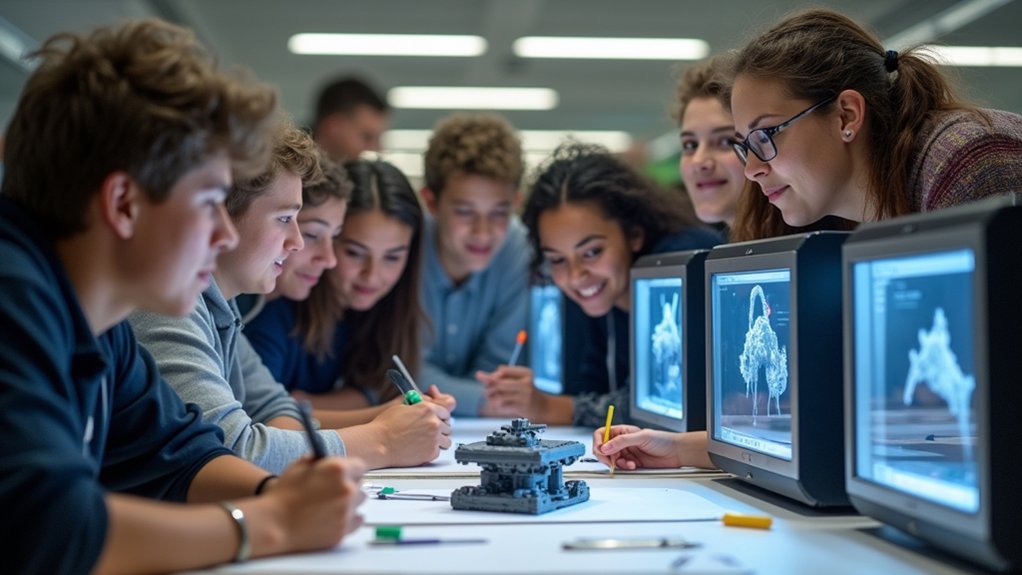
You’ll find the best high school 3D printing programs integrate hands-on project-based learning with professional-grade equipment like MakerBot METHOD printers and age-appropriate software from Tinkercad to Fusion 360. These programs align with STEM standards, emphasize real-world applications in healthcare, engineering, and architecture, and provide thorough teacher training. Students develop critical thinking skills while creating custom prosthetics, robotics components, and architectural models that prepare them for diverse career pathways and college admissions advantages in competitive STEM fields.
What Makes a 3D Printing Program Effective for High School Students

A blueprint transforms an architect’s vision into reality, and similarly, a well-structured 3D printing program transforms abstract STEM concepts into tangible learning experiences for high school students.
You’ll find that effective programs integrate hands-on projects that boost engagement and retention through experiential learning with printing technology.
Your students need access to user-friendly design software like Tinkercad for beginners, progressing to Fusion 360 for advanced learners. This progression develops both technical knowledge and problem-solving skills essential for future careers.
You should emphasize collaboration through project-based learning, connecting classroom concepts to real-world applications like engineering prototypes or medical models.
Thorough curriculum resources and support materials guarantee you can successfully implement and sustain your program long-term.
Essential Equipment and Software for High School 3D Printing Labs
Your lab’s foundation rests on selecting the right combination of hardware and software that’ll empower students to bring their digital designs to life.
Successful 3D printing programs require reliable equipment that can handle educational environments’ demands while providing software tools that grow with students’ abilities.
Essential components include:
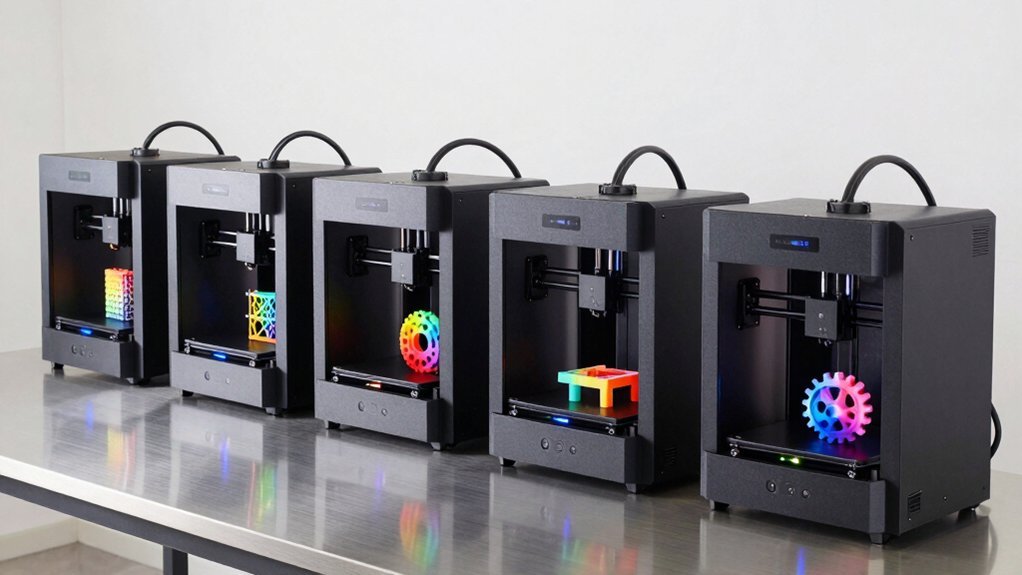
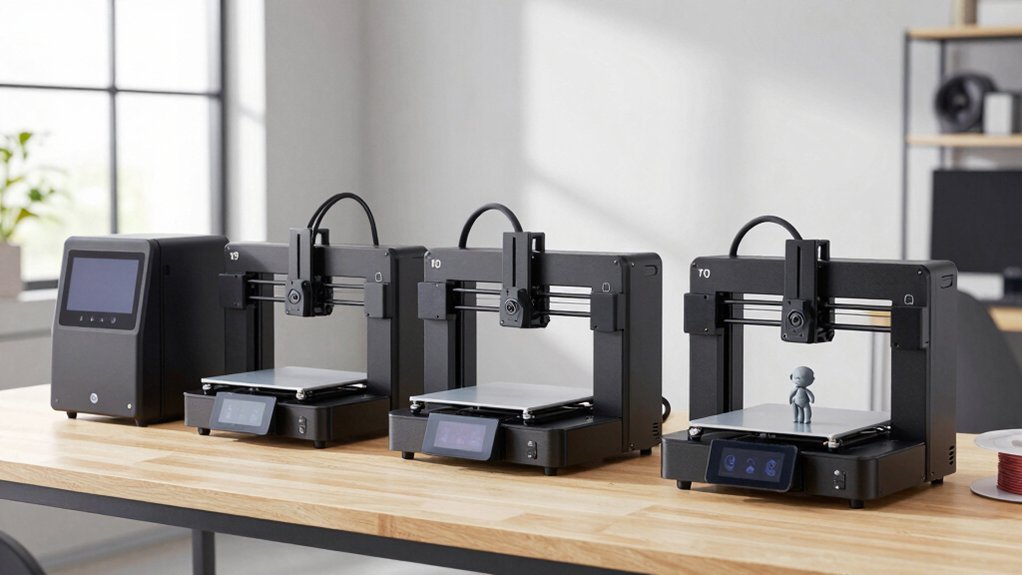
- Professional-grade printers like the MakerBot METHOD for precision work and LulzBot TAZ Pro S for multi-material projects supporting larger designs
- Age-appropriate software from beginner-friendly Tinkercad for foundational skills to advanced Fusion 360 for complex technical capabilities
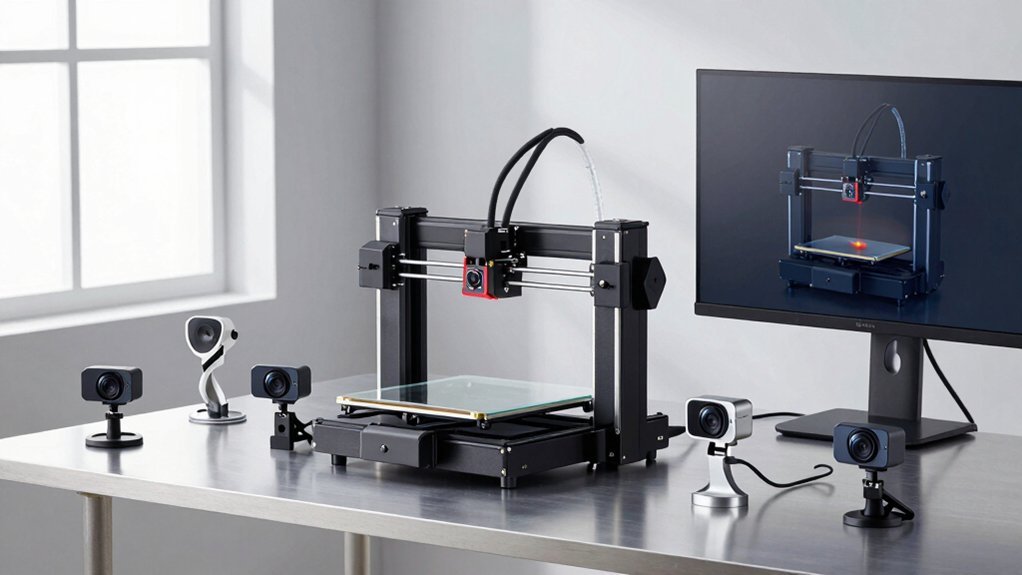
- Cloud-based management platforms such as Astroprint for seamless file transfer and coordinated printing workflows
You’ll also benefit from extensive training materials including lesson plans and hands-on projects that align with educational standards, plus access to supportive communities exceeding 300,000 users for collaboration and resource sharing.
Curriculum Design and Learning Objectives for 3D Printing Education

You’ll need to align your 3D printing curriculum with established STEM standards to guarantee educational credibility and measurable learning outcomes.
Your program should emphasize hands-on project development that challenges students to solve real-world problems while building spatial intelligence and design thinking skills.
You must implement robust assessment and evaluation methods that track student progress through iterative design processes and technical problem-solving scenarios.
STEM Standards Alignment
When designing 3D printing curricula for high school students, you’ll find that STEM standards alignment creates a powerful framework that bridges theoretical concepts with hands-on innovation.
This integration transforms traditional learning by embedding engineering and design principles directly into your classroom activities.
Your 3D printing program will effectively meet STEM standards through:
- Project-based learning experiences that apply mathematical concepts and scientific principles to real-world design challenges
- Development of spatial intelligence and design thinking skills essential for engineering and technology careers
- Integration of critical thinking and problem-solving methodologies that prepare students for future academic pursuits
Programs like NextWaveSTEM® provide extensive resources that support your teaching while maintaining educational standard compliance.
You’ll discover that 3D printing naturally fosters creativity and innovation, encouraging students to engage with technology applications that develop both technical skills and analytical thinking capabilities.
Hands-On Project Development
Because effective 3D printing education relies on experiential learning, hands-on project development forms the cornerstone of any successful high school curriculum.
You’ll need to design projects that mirror real-world applications, allowing students to bridge theoretical concepts with practical implementation. Through hands-on 3-D printing experiences, students learn essential design thinking skills while tackling authentic challenges.
Your curriculum should emphasize iterative processes where students prototype, test, and refine their designs. They’ll develop spatial intelligence through collaborative team projects that require problem-solving and critical analysis.
You’ll want to include projects addressing 3D printing constraints like support structures and overhangs, empowering students to troubleshoot effectively. This approach guarantees students gain practical experience while building confidence in engineering and product design fundamentals.
Assessment and Evaluation
Traditional testing methods fall short in evaluating 3D printing competencies, making project-based assessment your most effective tool for measuring student progress.
Project-based evaluations allow students to demonstrate design thinking, spatial intelligence, and problem-solving skills through tangible creations.
Your assessment methods should focus on these key areas:
- Design iteration process – Track how students improve designs based on feedback and testing results
- Technical proficiency – Evaluate mastery of software tools like Tinkercad and Fusion 360 through completed models
- Problem-solving documentation – Assess students’ ability to identify issues and implement creative solutions
Regular feedback sessions enable adaptive assessments that support personalized learning pathways.
You’ll find that students respond better when evaluations emphasize their creative process rather than just final outcomes, fostering deeper engagement with STEM concepts.
Career Pathways and Real-World Applications Students Can Explore

When you engage with 3D printing in high school, you’re opening doors to diverse career opportunities across multiple industries that actively use this technology.
You’ll discover how your classroom projects translate directly into real-world applications, from designing consumer products to creating medical devices and architectural models.
These hands-on experiences let you explore potential career paths while building practical skills that employers value in today’s technology-driven marketplace.
Industry Career Opportunities
As 3D printing technology transforms manufacturing across industries, students who participate in high school programs gain access to exciting career pathways that didn’t exist a generation ago.
You’ll discover opportunities spanning multiple sectors where additive manufacturing has become essential.
The U.S. Bureau of Labor Statistics projects 3% employment growth for industrial designers through 2030, reflecting increasing demand for 3D printing professionals.
Your hands-on experience developing spatial intelligence and design thinking skills will enhance your employability in competitive STEM fields.
Career opportunities include:
- Product design and engineering – Creating prototypes and manufacturing solutions
- Healthcare technology – Designing custom prosthetics and dental implants
- Architecture and fashion – Developing innovative structures and wearable designs
Colleges increasingly value applicants with practical 3D printing experience, giving you advantages in admissions and future career success.
Real-World Project Applications
Beyond exploring career possibilities, 3D printing high school programs immerse you in hands-on projects that mirror real industry challenges. You’ll design custom prosthetics for biomedical applications, create detailed architectural scale models, and develop fashion accessories that showcase innovation. These real-world applications prepare high school students for diverse career paths while building practical skills.
| Industry | Project Type | Skills Developed |
|---|---|---|
| Healthcare | Custom prosthetics | Biomedical design, patient-centered solutions |
| Architecture | Building scale models | Spatial reasoning, structural understanding |
| Fashion | Custom clothing/accessories | Creative design, market innovation |
| Engineering | Robotics/aerospace components | Mechanical design, technical precision |
Through partnerships with local businesses, you’ll tackle actual industry problems, connecting directly with potential employers while gaining invaluable insights into professional 3D printing applications that extend far beyond classroom theory.
Implementation Strategies for Bringing 3D Printing to Your High School
Five essential steps can transform your high school into a hub of 3D printing innovation. Start by conducting thorough assessments of student and faculty interests to guarantee your program aligns with educational objectives. This foundation determines how you’ll integrate the use of 3D printing across different subjects.
Next, establish partnerships with organizations like NextWaveSTEM® to access extensive printing educational resources and professional development opportunities. These collaborations provide essential curriculum support and training.
Consider these key implementation elements:
- Deploy appropriate printer software like Tinkercad for beginners and Fusion 360 for advanced learners
- Launch after-school programs to encourage creative exploration in informal settings
- Establish monitoring systems to evaluate program effectiveness
Finally, continuously assess student engagement and learning outcomes, making necessary adjustments to optimize your 3D printing program’s educational impact.
Student Projects and Hands-On Learning Opportunities
When students immerse themselves in 3D printing projects, they transform abstract concepts into tangible creations that showcase their problem-solving abilities.
You’ll find students designing custom prosthetics, architectural models, and functional tools that address real community needs. Through collaborative projects, they develop teamwork skills while iterating on their designs together.
Students can print robotics competition parts, applying theoretical knowledge in practical settings that align with educational standards.
Advanced design software like Fusion 360 enhances their technical capabilities, preparing them for engineering and product design careers.
After-school printing programs extend learning opportunities beyond traditional classrooms, fostering creativity and innovation.
These hands-on experiences allow students to engage with cutting-edge technology while building essential skills for their future academic and professional endeavors.
Teacher Training and Professional Development Requirements
Although 3D printing technology offers tremendous educational potential, teachers need extensive training programs to successfully integrate these tools into their classrooms.
Professional development requires thorough preparation to guarantee you’re equipped with essential skills for effective printing in the classroom implementation.
Quality teacher training programs typically include:
- Hands-on workshops covering 3D design software, engineering principles, and technology integration techniques
- Curriculum resources aligned with state and national educational standards for seamless lesson incorporation
- Ongoing technical support with access to detailed teaching materials and troubleshooting assistance
Organizations like NextWaveSTEM® provide specialized professional development opportunities that focus on best practices and classroom implementation strategies.
You’ll also find certification programs available to enhance your qualifications, giving you recognized credentials in teaching 3D printing and related STEM subjects while building confidence to guide student projects effectively.
Frequently Asked Questions
What Is the Best 3D Printer for High School?
You’ll find the MakerBot SKETCH Classroom bundle offers exceptional value with two printers and materials included. It’s cost-effective, curriculum-friendly, and provides ISTE-aligned certification resources for seamless educational integration.
What Is the Best Program to Learn for 3D Printing?
You’ll want to start with Tinkercad since it’s user-friendly and perfect for beginners. Once you’ve mastered basics, advance to Fusion 360 for more sophisticated design capabilities and professional-level features.
What 3D Printing Software Do Schools Use?
You’ll find schools use Tinkercad for grades 3-8, Fusion 360 for high school, and Astroprint for cloud-based printing management. Many also incorporate Blender and SketchUp to meet specific curriculum needs.
What Is the Best Type of 3D Printing for Education?
You’ll find FDM printers work best for education since they’re affordable, user-friendly, and perfect for beginners. They let you create hands-on projects that boost creativity across engineering, art, and science subjects.

Leave a Reply