You can deduct 100% of your 3D printer’s cost through Section 179, allowing up to $1,220,000 in deductions for 2024. Your equipment must serve business purposes exclusively, and you’ll need proper documentation proving business use throughout the tax year. If you exceed spending caps, 60% Bonus Depreciation applies to remaining equipment. Material costs like filaments and resins are also deductible business expenses. Strategic timing and understanding state-specific exemptions can maximize your savings even further.
Section 179 Deduction Basics for 3D Printing Equipment
When you’re looking to maximize tax savings on your 3D printing equipment purchases, the Section 179 Deduction offers one of the most powerful tools available to small and medium-sized businesses.
This small business tax incentive lets you deduct the full purchase price of qualified property—up to $1,080,000 for 2022—in the year you put into service your 3D printers and post-processing equipment.
Section 179 enables immediate full deduction of 3D printing equipment costs up to $1,080,000 in the service year.
You’ll face a spending cap of $2,700,000, after which your tax deduction reduces dollar-for-dollar.
If you exceed $3,780,000 in equipment purchases, you won’t qualify for Section 179.
However, you can still benefit from 100% Bonus Depreciation on remaining 3D printing equipment, ensuring you capture maximum tax savings regardless of your spending level.
2024 Deduction Limits and Spending Caps
Understanding Section 179 deduction limits becomes critical as your 3D printing equipment investments grow larger. The tax deduction limits you’ll face depend on your tax year and total qualifying equipment purchases.
| Tax Year | Section 179 Deduction | Spending Cap |
|---|---|---|
| 2022 | $1,080,000 | $2,700,000 |
| 2024 | $1,220,000 | $3,050,000 |
Once you exceed the spending cap, your Section 179 deduction reduces dollar-for-dollar. Larger businesses spending over $3,780,000 in 2022 or $4,270,000 in 2024 can’t claim this deduction at all. However, you can still benefit from Bonus Depreciation on the full purchase price after reaching limits. Consult a tax professional to maximize your 3D printer write-offs effectively.
Qualifying Criteria for 3D Printer Tax Write-Offs
To claim tax write-offs on your 3D printer, you’ll need to meet specific IRS requirements that determine eligibility.
Your equipment must serve business purposes exclusively, be acquired within the correct timeframe, and fall within established spending thresholds.
Understanding these three qualifying criteria guarantees you’ll maximize your deductions while staying compliant with federal tax regulations.
Business Use Requirements
Since the IRS requires clear business purpose for equipment deductions, your 3D printer must serve primarily business functions to qualify for tax write-offs.
You can’t use the equipment for personal projects if you want to claim the full business deduction. The IRS specifically excludes any personal use when determining qualifying equipment eligibility.
Your business must demonstrate that the 3D printer purchase directly supports operational activities, whether you’re prototyping products, creating marketing materials, or manufacturing components.
Under Section 179 rules, you’ll need to maintain detailed records showing exclusive business use throughout the tax year. This documentation becomes essential during audits, as the IRS will verify your claimed business purpose against actual usage patterns and supporting invoices.
Equipment Purchase Timing
When you purchase your 3D printer matters just as much as how you’ll use it for business purposes.
To claim the Section 179 Deduction available for your 3D printer, the equipment must be financed or purchased and put into service during the current tax year.
The deduction limit for 2022 stands at $1,080,000, but there’s a spending cap that makes Section 179 benefits phase out after $2,700,000 in total equipment purchases.
If you’re eligible for this partial reduction or exceed the limit, don’t worry—this tax deduction allows businesses to claim 100% Bonus Depreciation as an alternative.
Spending Limit Thresholds
Three key spending thresholds determine whether you’ll qualify for Section 179 deductions on your 3D printer purchases.
The Section 179 Spending Cap allows you to deduct the full purchase price up to $1,080,000 for your deduction for tax year 2022.
However, when your total equipment investments reach the spending cap of $2,700,000, your available deductions begin reducing dollar-for-dollar.
Businesses spending over $3,780,000 lose eligibility completely and aren’t eligible for the Section 179 deduction.
For any tax exemption, you must guarantee your 3D printers are used for business purposes exclusively, with no personal use allowed.
Whether financing or purchased and put into service, both new and used equipment qualifies within these spending limits.
Bonus Depreciation Rules for Manufacturing Equipment
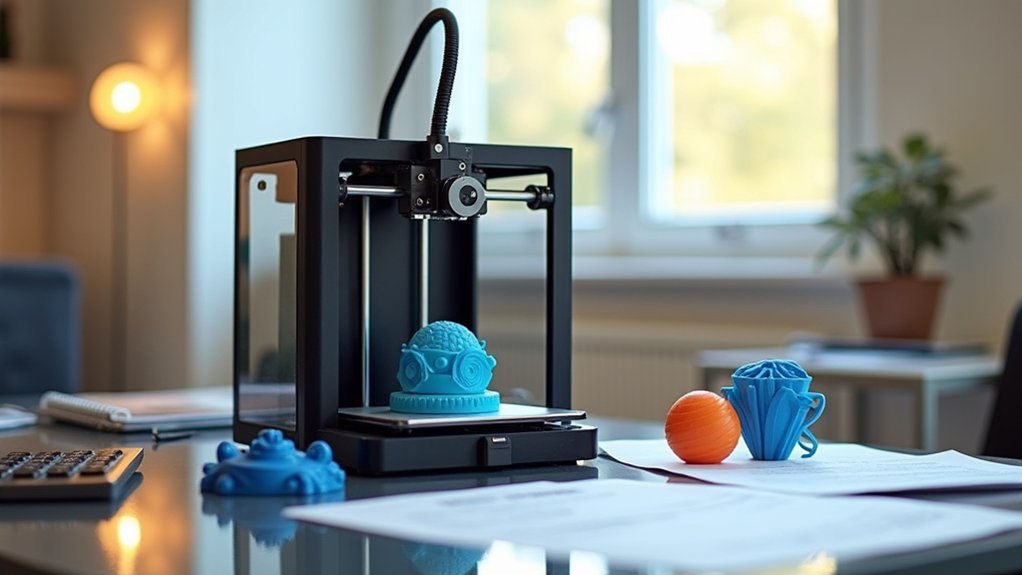
When you’ve maxed out your Section 179 deduction limits, Bonus Depreciation becomes your next powerful tax strategy for 3D printer purchases.
You’ll get a 60% deduction rate in 2024 on qualifying manufacturing equipment, including both new and used 3D printers.
Your equipment must meet specific qualification requirements and be used primarily for business purposes to claim this substantial tax benefit.
60% Deduction Rate
Sixty percent of your qualified manufacturing equipment’s cost can be deducted through Bonus Depreciation in 2024, but only after you’ve exhausted your Section 179 deduction limit.
This deduction rate applies to your 3D printing equipment purchases, whether you’re buying qualified new and used equipment for your manufacturing sector operations.
The current 60% rate won’t last forever. You’ll see this financial incentive decrease to 40% in 2025 and drop further to 20% in 2026.
This declining schedule creates urgency for your equipment investments. To claim the full 60% deduction rate, you must finance or purchase your 3D printing equipment and put it into service by December 31, 2024.
This tax incentive considerably reduces your tax burden while encouraging equipment upgrades.
Equipment Qualification Requirements
Before you can claim bonus depreciation on your 3D printing equipment, you must guarantee it meets specific qualification requirements that determine your eligibility for this substantial tax benefit.
Your equipment qualification requirements for the Section 179 tax incentive and bonus depreciation include:
- Equipment Status: Both new and used equipment qualify for bonus depreciation, expanding your options for tax savings on eligible equipment purchases.
- Service Timeline: Your 3D printer must be placed in service during the same tax year you’re claiming the deduction to qualify for the benefits.
- Usage Requirements: The equipment must be used primarily for business purposes, as any personal use disqualifies it from bonus depreciation benefits.
Business Use Requirements and Documentation
Although 3D printers can serve both personal and professional purposes, you’ll only qualify for tax deductions when you use the equipment primarily for business activities.
Business use requirements mandate that your 3D printers serve legitimate business purposes to claim tax write-offs.
Proper documentation forms the foundation of successful deductions. You’ll need receipts and invoices for equipment purchases to support your claims.
If you’re claiming the Section 179 Deduction for immediate expensing, maintain records showing the printer was purchased and operational within the tax year.
Keep detailed depreciation schedules if you’re deducting costs over time.
Most importantly, maintain usage logs documenting business activities versus personal use. This documentation protects you during an IRS audit by proving your equipment primarily serves business functions.
Material Costs and Consumables Deductions
Beyond the initial equipment purchase, your 3D printing materials represent ongoing deductible expenses that can greatly impact your bottom line.
Material costs including filaments, resins, and powders qualify as business expenses, reducing your taxable income. Consumables like support materials and cleaning supplies also count toward tax deductions when used in production.
Every filament spool, resin bottle, and cleaning solvent used in your 3D printing business reduces your taxable income through legitimate material expense deductions.
Here’s how to maximize your material-related deductions:
- Track everything meticulously – Document all material costs for accurate Cost of Goods Sold calculations and proper tax filing.
- Consider bulk purchasing strategies – Buy materials in larger quantities to reduce costs while maintaining detailed documentation for deductions.
- Explore R&D tax credits – Materials used in developing new products may qualify for additional financial incentives beyond standard deductions.
Research and Development Tax Credit Opportunities
When you’re developing new 3D printing processes or pioneering innovative products, you’re likely eligible for Research and Development tax credits that go far beyond standard business deductions.
The R&D tax credit rewards qualified research expenses including employee wages directly involved in research, supply costs, and contract research expenses for your 3D printing innovations.
To qualify, you must demonstrate your projects involve technological uncertainties and aim to improve processes through experimentation.
Accurate documentation is essential—maintain detailed records with project descriptions, cost calculations, and timelines supporting your claims.
Beyond federal credits, state R&D tax incentives can amplify your tax savings.
These combined benefits make innovative technologies particularly attractive investments, transforming your 3D printing research expenses into substantial credits that directly reduce your tax liability.
State-Specific Tax Exemptions for Manufacturing Equipment
You’ll find that state-specific exemptions can greatly reduce your 3D printer costs, with California leading the way through its partial sales and use tax exemption for manufacturing equipment.
California’s program cuts taxes by 3.9375% on qualified manufacturing and R&D equipment purchases, but you must meet specific qualification requirements and use the equipment more than 50% of the time for eligible activities.
Other states offer similar regional programs with varying qualification standards, so you should research your local tax laws to maximize potential savings on your 3D printing investments.
California Manufacturing Equipment Exemption
Although federal tax deductions provide substantial savings for 3D printer purchases, California offers an additional layer of benefits through its Manufacturing Equipment Exemption that can greatly reduce your upfront costs.
This exemption reduces sales and use taxes by 3.9375% on qualified manufacturing equipment, including 3D printing equipment, through June 30, 2030.
To qualify, you must meet specific criteria:
- Business Classification: You must be a “qualified person” engaged in eligible activities like manufacturing, processing, or R&D.
- Usage Requirements: Your 3D printing equipment must be used more than 50% of the time in qualifying manufacturing processes.
- Documentation: Complete Form BOE-230 for detailed calculations and eligibility confirmation.
The California Manufacturing Equipment Exemption covers machinery, tools, and other tangible assets necessary for manufacturing.
Consult a tax professional to verify your 3D printing equipment qualifies for this exemption.
State Sales Tax Reductions
Beyond California’s manufacturing exemption, several states offer targeted sales tax reductions that can remarkably lower your 3D printer acquisition costs.
These partial exemptions typically require your business to qualify as engaged in manufacturing, processing, or R&D activities. Your 3D printers must be used more than 50% of the time in eligible activities to receive the tax exemption benefits.
Most states require specific documentation proving your qualified purchases meet manufacturing equipment criteria. You’ll need to demonstrate that your equipment directly supports production processes rather than general business operations.
The sales tax reduction amounts vary considerably between jurisdictions, with some offering substantial savings on manufacturing equipment investments.
Always consult a tax professional familiar with your state’s requirements and complete necessary forms like California’s Form BOE-230 for proper compliance verification.
Regional Qualification Requirements
Understanding California’s specific qualification criteria becomes essential when pursuing the state’s 3.9375% partial sales and use tax exemption for manufacturing equipment.
Your business must meet strict requirements to claim this California exemption for 3D printing equipment purchases.
You’ll need to satisfy these key regional qualification requirements:
- Qualified Person Status – Your business must be classified as a “qualified person” actively engaged in manufacturing or R&D activities within California’s jurisdiction.
- Equipment Usage Threshold – Your 3D printing equipment must be used more than 50% of the time for qualifying manufacturing, processing, fabricating, or R&D activities.
- Professional Verification – Consult a tax professional to guarantee compliance with both the partial sales tax exemption and Section 179 deduction requirements before claiming this tax exemption.
Record-Keeping Requirements for Equipment Purchases
How can you guarantee your 3D printer tax deduction withstands IRS scrutiny?
Maintaining meticulous record-keeping for equipment purchases is essential. You must retain all receipts and invoices to substantiate tax write-offs under Section 179.
Keep accurate, updated depreciation schedules for each piece of equipment to confirm compliance with IRS regulations. Your documentation must clearly demonstrate business use of the equipment, as any personal use can disqualify your deduction.
If you’ve leased or financed your 3D printer, maintain precise records of financing agreements to validate claimed deductions.
Regularly review your record-keeping practices to meet federal and state tax compliance requirements. Proper documentation protects your deductions and guarantees you’re prepared for potential audits or IRS inquiries.
Maximizing Tax Savings Through Strategic Purchase Timing
When you purchase your 3D printer before December 31st, you’ll access maximum tax benefits through Section 179’s generous deduction limits.
Strategic purchase timing maximizes your tax savings by guaranteeing you stay within the $3,050,000 spending cap for full write-off eligibility.
Your equipment purchases can generate substantial deductions through careful planning:
- Claim up to $1,220,000 in Section 179 deductions for 3D printing technology placed in service by year-end
- Leverage 60% bonus depreciation on qualifying assets after reaching the spending cap threshold
- Combine year-end promotions with tax incentives to maximize both immediate savings and deductions
You’ll need to confirm your equipment serves legitimate business purposes and maintain compliance with IRS regulations.
Planning your acquisitions strategically helps you capture both immediate tax benefits and long-term equipment value.
Frequently Asked Questions
What Is the 45 Degree Rule for 3D Printing?
You’ll need supports for overhangs exceeding 45 degrees from vertical. This rule prevents sagging and guarantees proper layer adhesion. It’s your guide for creating print-friendly designs while minimizing support material usage.
What Is the Most Overlooked Tax Break?
You’re missing out on deducting used equipment purchases. Most businesses only claim new 3D printers for Section 179 deductions, but you can also write off qualifying used equipment, potentially doubling your tax savings.
What Proof Do You Need for Tax Write-Offs?
You’ll need receipts or invoices showing purchase costs, documentation proving business use, detailed depreciation schedules, records of material expenses, and any financing agreements to support your tax write-off claims.
Can You Write off 100% of Equipment?
You can write off 100% of qualifying equipment costs through Section 179 deduction up to $1,220,000 in 2024, plus use 60% Bonus Depreciation for additional equipment costs.



Leave a Reply