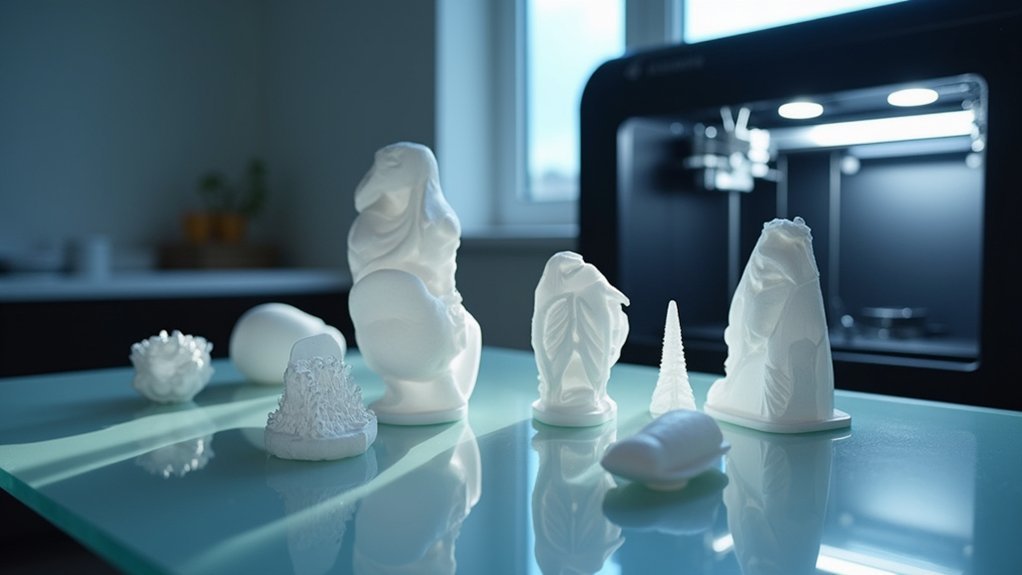
You’ll need to prioritize biocompatibility testing and material selection first, choosing FDA-compliant materials like PLA for basic applications or titanium for implants. Ascertain regulatory compliance from day one by integrating ISO 13485:2016 and 21 CFR Part 820 requirements into your design process. Select the right 3D printing technology—SLA for precision, SLS for complex geometries, or DMLS for metal components. Design for functionality and testability with modular components and accessible test points. Implement quality management systems early, validate mechanical properties through standardized testing, and plan iterative cycles for continuous improvement. The complete framework encompasses even more critical considerations for successful medical prototype development.
Prioritize Biocompatibility Testing and Material Selection

When developing 3D printed medical prototypes, you must prioritize biocompatibility testing and material selection as your fundamental starting point.
Your choice of materials directly impacts patient safety, with requirements varying based on device contact type according to ISO standards. Select appropriate materials like Polylactic Acid for basic applications or Titanium for implants requiring superior strength and compatibility.
Material selection fundamentally determines patient safety outcomes, with ISO standards dictating specific requirements based on device-tissue contact classifications.
Document your testing procedures thoroughly, ensuring alignment with regulatory guidelines including FDA regulations under 21 CFR Part 820 and ISO 10993 for medical devices.
Implement continuous monitoring during development to identify potential adverse reactions early.
Establish a robust Quality Management System to maintain compliance with biocompatibility requirements, ensuring all materials meet safety standards before production.
Ensure Regulatory Compliance From Design Phase
Building upon your material selection foundation, regulatory compliance must become an integral part of your design methodology rather than an afterthought.
You’ll need to incorporate FDA regulations from 21 CFR Part 820 and ISO 13485:2016 into your prototype design process, establishing a robust quality management system from day one.
Conduct biocompatibility assessments early, following ISO standards to validate material safety for medical devices.
Don’t wait until later stages—implement real-world validation processes during initial design phases to enhance functionality and compliance simultaneously.
Collaborate with regulatory experts to identify specific requirements for your device category.
This proactive approach guarantees your 3D printed prototypes align with necessary compliance standards, streamlining your path to regulatory approval while maintaining thorough documentation and traceability throughout development.
Select the Optimal 3D Printing Technology for Your Application

Five distinct 3D printing technologies dominate medical prototyping, each offering unique advantages that’ll determine your prototype’s success.
SLA delivers exceptional resolution and precision for detailed medical prototypes requiring smooth surface finishes.
When you need complex geometries and functional prototyping capabilities, SLS excels at producing intricate designs without support structures.
FDM offers an affordable solution for moderate-complexity functional parts, making it perfect for budget-conscious medical device development.
For metal components requiring biocompatible materials, DMLS provides the strength and durability needed for end-use medical devices.
Your technology choice must align with desired material properties and specific application requirements.
Rapid prototyping enables fast design iterations, allowing validation within hours while considerably reducing development costs and accelerating your medical device timeline.
Design for Functionality and Testability
Since medical prototypes must undergo rigorous testing before advancing to clinical trials, you’ll need to design components that prioritize both functionality and easy evaluation access.
Create modular designs that enable quick assembly and disassembly, allowing you to swap components during testing phases. Integrate dedicated test points and measurement features directly into your prototypes to streamline performance evaluation and data collection.
Modular prototype architecture with integrated test points accelerates component evaluation and ensures rapid iteration during critical development phases.
Design secure enclosures that properly accommodate electronic components while maintaining accessibility for troubleshooting. You’ll want critical features positioned where they’re easily reached during testing procedures.
Document your design specifications thoroughly and label all components clearly—this prevents confusion during evaluations and accelerates the troubleshooting process.
Thoughtful planning around testability guarantees your medical prototypes function reliably while supporting thorough assessment protocols.
Implement Quality Management Systems Early

You’ll need to establish a regulatory compliance framework that aligns with ISO 13485:2016 and FDA requirements from the start of your prototype development.
Your documentation and record keeping processes must capture every critical decision, test result, and design change to support future regulatory submissions.
You should also integrate biocompatibility testing standards early to guarantee your materials and processes meet safety requirements before moving into clinical phases.
Regulatory Compliance Framework
While developing 3D printed medical prototypes, you’ll need to establish a Quality Management System (QMS) from day one to ascertain compliance with ISO 13485 and FDA regulations under 21 CFR Part 820.
This framework guarantees your medical devices meet regulatory compliance standards throughout development.
Your regulatory compliance framework should include:
- Documentation and traceability protocols that capture every manufacturing step, design change, and quality check for complete audit trails.
- Risk management processes following ISO 14971 to identify, assess, and mitigate potential hazards early in development.
- Continuous monitoring systems that track manufacturing variables and prototype performance against safety criteria.
Implementing these elements early streamlines regulatory submissions and accelerates approval processes.
You’ll reduce time-to-market while maintaining the highest quality standards for your 3D printed prototypes.
Documentation and Record Keeping
Proper documentation and record keeping form the backbone of your QMS implementation for 3D printed medical prototypes.
You’ll need thorough quality records that demonstrate compliance with ISO 13485 and FDA requirements throughout your development process.
Establish clear documentation practices covering material specifications, production methods, and post-processing procedures. This creates essential traceability for design changes, testing outcomes, and manufacturing protocols.
Your records must show adherence to established procedures, proving product reliability during regulatory submissions and audits.
Implement continuous monitoring systems to track quality metrics and process improvements.
Consider software solutions like Greenlight Guru to automate documentation workflows, reducing human error while maintaining regulatory compliance.
Consistent record keeping guarantees your quality management system supports both approval processes and long-term patient safety requirements.
Biocompatibility Testing Standards
Since biocompatibility testing determines whether your 3D printed medical prototype is safe for patient contact, you must integrate these evaluations into your quality management system from day one.
This approach guarantees regulatory compliance with ISO 10993 standards while establishing proper documentation protocols.
Your biocompatibility evaluations must consider three critical factors:
- Device contact type – Surface contact versus implanted medical devices require different testing protocols
- Duration of exposure – Short-term versus long-term patient contact affects testing requirements
- Intended use – Specific application determines appropriate ISO 10993 test methods
Manufacturers like Formlabs conduct biocompatibility testing following strict ISO standards, validating their printing and post-processing instructions.
Implementing robust risk management through your Quality Management System enhances product reliability and supports traceability throughout testing processes.
Document Everything Throughout Development
Because regulatory compliance forms the backbone of successful medical device development, you must document every aspect of your 3D printed prototype’s journey from initial concept to final testing.
Documenting all stages guarantees compliance with FDA regulations and ISO 13485:2016 certification requirements. Your Quality Management System should track design iterations, materials specifications, and testing results to establish complete traceability throughout development.
Comprehensive documentation streamlines validation processes during regulatory submissions, demonstrating your device’s functionality and safety.
You’ll identify improvement opportunities while reducing costly errors in later stages. Detailed records enhance collaboration among team members and stakeholders, keeping everyone aligned on design specifications and testing criteria.
This systematic approach transforms potential regulatory hurdles into manageable checkpoints, accelerating your pathway to market approval.
Validate Mechanical Properties Against Requirements
You must establish rigorous testing protocol standards that align with ISO 13485:2016 and ISO 10993 to guarantee your prototypes meet regulatory requirements.
Conduct thorough material property analysis through tensile and compression tests to quantify mechanical characteristics like strength, flexibility, and durability under intended use conditions.
Document all validation results within your quality management system to support regulatory compliance and demonstrate that your prototype’s performance matches the functional criteria of traditionally manufactured medical devices.
Testing Protocol Standards
While regulatory compliance might seem intimidating, establishing rigorous testing protocol standards for your 3D printed medical prototypes guarantees they’ll meet critical mechanical property requirements before moving to clinical applications.
You’ll need to implement thorough testing protocols that align with regulatory standards like ISO 10993 for biocompatibility and ISO 13485 for quality management.
Your mechanical testing strategy should include:
- ASTM D638 and D790 testing for accurate tensile and flexural property assessment under standardized conditions
- Real-world simulation validation processes that replicate expected clinical loads and operating conditions
- Robust quality management system documentation ensuring complete traceability of all mechanical testing results
Continuous monitoring throughout production helps you identify variations that could compromise performance, while proper validation processes ensure your prototypes will function reliably in clinical environments.
Material Property Analysis
Effective testing protocols lay the foundation for thorough material property analysis, where you’ll systematically validate that your selected 3D printing materials deliver the specific mechanical performance your medical prototype demands.
Apply standardized testing methods like ASTM D638 for evaluating tensile strength and ISO 10993 for biocompatibility assessment.
Different 3D printing technologies such as SLA and SLS produce varying mechanical properties, so you’ll need to account for these variations during material selection.
Compare your 3D printed prototypes against traditionally manufactured parts to identify performance gaps.
Implement a robust quality management system compliant with ISO 13485:2016 to document all testing results.
This systematic approach helps you optimize material selection while ensuring regulatory compliance for medical device manufacturing.
Plan for Iterative Design and Testing Cycles
Since medical device development demands precision and regulatory compliance, establishing a structured approach to iterative design cycles becomes essential for your 3D printing projects.
Rapid prototyping through 3D printing technology enables you to complete design iterations within hours, dramatically reducing development costs while accelerating your product development timeline.
Your iterative design process should incorporate real-world validation at each stage, ensuring prototypes meet both functional requirements and regulatory standards for medical devices.
The flexibility of 3D printing allows you to create complex geometries and refine them based on testing feedback.
- Complete rapid prototyping cycles within hours to minimize development time
- Integrate feedback from testing into each design iteration for continuous improvement
- Validate prototypes against regulatory requirements early in the development process
Consider Post-Processing Requirements and Capabilities
Beyond refining your design through testing cycles, you must account for the specific post-processing steps that’ll transform your raw 3D printed medical prototype into a finished, regulation-compliant device.
Your post-processing choices directly impact surface finishes, mechanical properties, and biocompatibility—all critical for meeting regulatory standards.
Select techniques that align with your materials used, whether you’re working with metals requiring machining or resins needing sanding.
Methods like bead blasting improve surface quality, while protective coatings enhance durability and wear resistance.
Include thorough post-processing evaluation in your prototyping plan to prevent delays and guarantee quality enhancement.
Establish Clear Prototype-to-Production Pathways
While your prototype may function perfectly in testing, its success ultimately depends on how smoothly you can move from initial design to full-scale production.
Establishing clear prototype-to-production pathways for your 3D printed medical devices greatly reduces time-to-market and manufacturing costs.
Rapid prototyping with 3D printing enables quick design iterations, but you’ll need structured processes to bridge the gap between prototypes and scalable production.
Your design teams should collaborate with regulatory experts early to identify compliance issues before they become costly problems.
- Implement a robust quality management system that guarantees prototypes meet regulatory compliance standards from day one
- Document every stage of prototype development, including testing outcomes and design adjustments for regulatory submissions
- Create standardized production pathways that seamlessly convert validated prototypes into your manufacturing process
Frequently Asked Questions
What Are the Challenges of Using 3D Printing in the Medical Field?
You’ll face regulatory compliance hurdles, biocompatibility testing complexities, material property variability, and quality management challenges. You’ll also encounter uncertainties as rapidly advancing technology outpaces existing regulatory frameworks, complicating device approval processes.
What Is the Best Material for 3D Printing Prototypes?
You’ll want to choose materials based on your prototype’s purpose. For basic testing, use PLA. For durability, select ABS or Nylon PA 12. For implants, PEEK and titanium offer biocompatibility and strength.
What Are the Techniques Used in 3D Printing in a Medical Setting?
You’ll encounter several 3D printing techniques in medical settings: SLA for high-resolution surgical guides, SLS for durable functional prototypes, FDM for affordable device parts, and DMLS for strong biocompatible metal implants.
What Is the Trend in 3D Printing Medical Devices?
You’ll see explosive growth in 3D printed medical devices, with the market expanding from $1 billion to nearly $6 billion by 2030. Customization, biocompatibility, and regulatory compliance are driving this transformation.


Leave a Reply