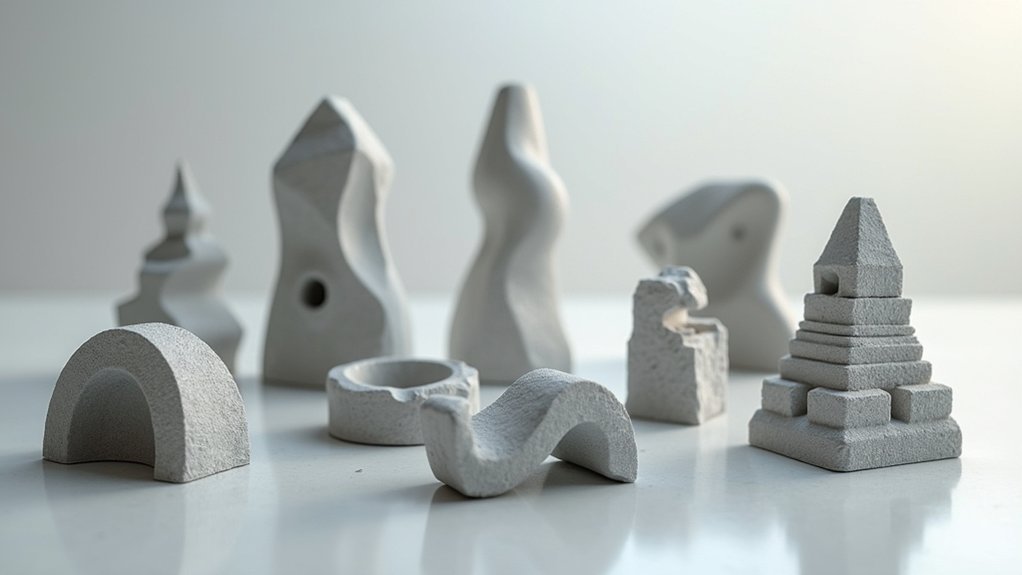
You can 3D print structural walls exceeding 100 MPa compressive strength, custom formwork reducing costs by 30%, decorative facade panels with intricate patterns, precise foundation footings, artistic staircases serving as functional art, precast concrete slabs three times faster than traditional methods, architectural details like cornices and moldings, urban furniture and infrastructure elements, and custom beams with integrated reinforcement. These components achieve superior precision while minimizing waste and accelerating construction timelines. Discover how each transforms your building projects.
Structural Walls and Load-Bearing Elements
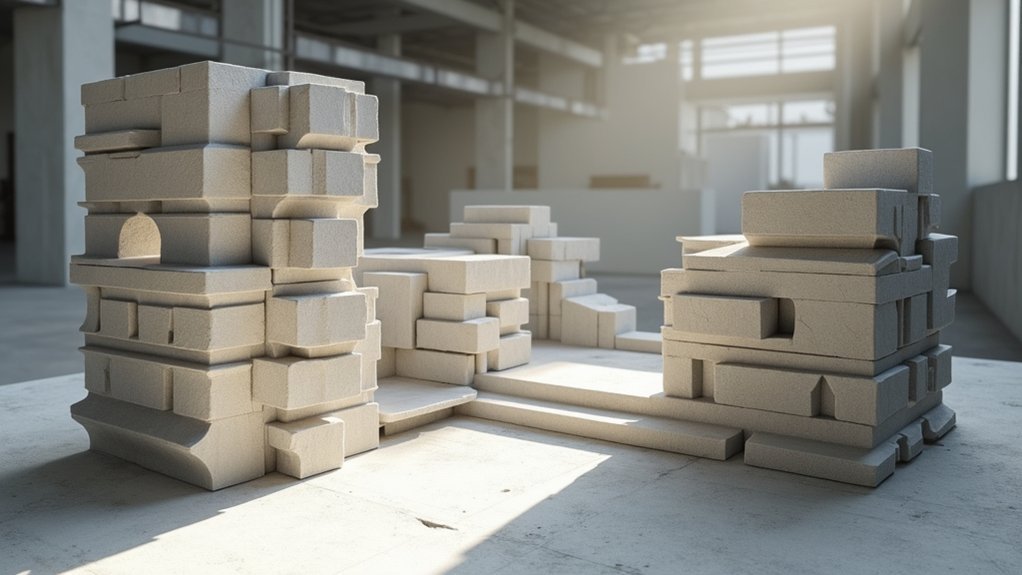
While traditional construction methods often limit design flexibility and generate substantial waste, 3D printing technology revolutionizes how you can create structural walls and load-bearing elements.
Through concrete printing, you’ll achieve compressive strengths exceeding 100 MPa using high-performance mixtures with fly ash and silica fume admixtures. You can integrate plumbing and electrical systems directly into walls during printing, eliminating post-construction installations.
The technology lets you design hollow or reinforced load-bearing elements that optimize material usage while maintaining structural integrity. You’ll also incorporate insulation materials directly into printed walls, enhancing thermal performance and energy efficiency.
3D printing optimizes structural design through hollow load-bearing elements while integrating insulation for superior thermal performance and material efficiency.
This customizable approach reduces both material waste and labor costs while accommodating complex architectural designs that traditional methods can’t achieve.
Concrete Formwork and Molds
Innovation in formwork technology transforms how you’ll approach concrete construction projects. 3D printed molds and formwork systems deliver complex geometries three times faster than traditional methods while cutting formwork costs by up to 30% – a substantial savings considering that concrete formwork typically represents 40-60% of your project’s total budget.
Concrete 3D printing enables you to create custom facade panels and precast concrete stairs with innovative architectural designs that weren’t feasible before. The production process involves designing specific geometries, printing components, assembling parts when necessary, and cleaning for reuse – promoting sustainability throughout your construction workflow.
3D printed formwork provides the efficiency and flexibility you need for modern construction’s complexity requirements, revolutionizing how you’ll execute concrete projects.
Decorative Facade Panels and Cladding
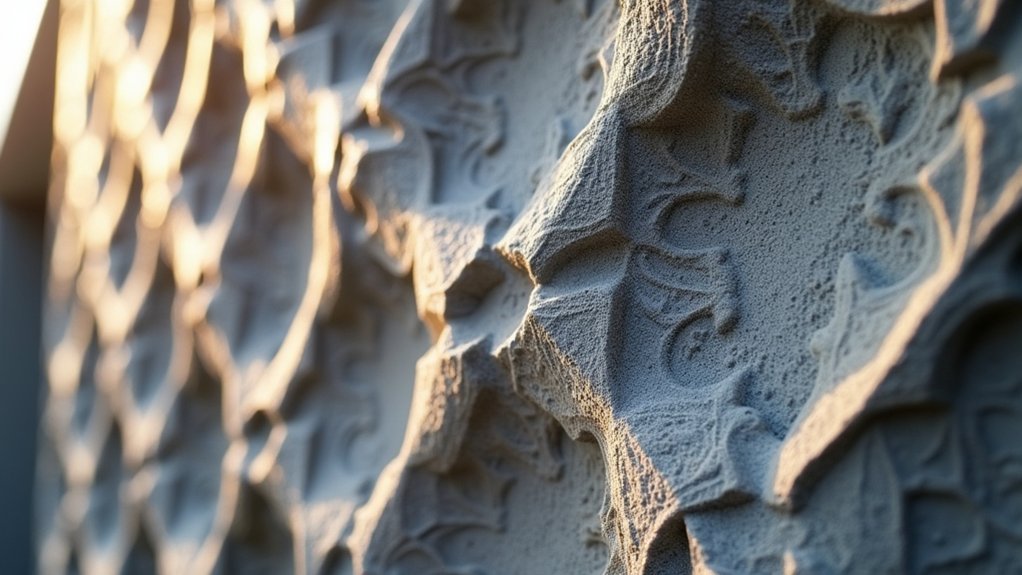
You can now create intricate custom patterns and complex geometric designs for facade panels that weren’t possible with traditional concrete forming methods.
3D printing technology lets you produce these sophisticated architectural elements three times faster than conventional techniques while cutting production costs by up to 30%.
This combination of speed and affordability makes decorative concrete cladding accessible for projects where custom aesthetics were previously cost-prohibitive.
Custom Pattern Creation
Because traditional construction methods limit architects to basic geometric patterns and simple textures, 3D printing technology has revolutionized facade design by enabling the creation of intricate decorative panels and cladding that push creative boundaries.
With a concrete 3D printer, you can produce custom pattern facade panels featuring complex geometries that would be impossible to achieve through conventional techniques.
You’ll complete production three times faster than traditional methods, considerably reducing project timelines.
The flexibility of 3D printing allows you to rapidly iterate and modify designs, ensuring your clients achieve their desired visual impact without delays.
You can also integrate smart technologies directly into facade designs, enhancing both functionality and aesthetic appeal while maintaining cost-effectiveness throughout the construction process.
Cost-Effective Complex Geometries
Complex geometries that once demanded expensive custom molds and extensive skilled labor now become accessible through 3D printing technology, fundamentally changing how you approach decorative facade projects. You’ll discover that complex geometries previously impossible with traditional methods can now be created cost-effectively, reducing construction expenses by approximately 30%.
| Aspect | Traditional Methods | 3D Printing |
|---|---|---|
| Production Speed | Standard timeline | 3x faster |
| Design Complexity | Limited by molds | Unlimited geometries |
| Labor Requirements | Highly skilled workers | Minimal supervision |
| Material Waste | Significant excess | Minimized waste |
| Cost Reduction | Baseline pricing | 30% savings |
Your projects benefit from faster turnaround times while achieving architectural diversity that enhances aesthetic appeal. Smart technology integration enables energy-efficient designs and self-sensing materials, maximizing building functionality.
Foundation Components and Footings
When you’re constructing foundation components and footings using 3D printing technology, you’ll discover precision and efficiency that traditional methods simply can’t match.
You can create tailored foundation components that meet specific design requirements while eliminating labor-intensive traditional approaches. By utilizing 3D printed formwork, you’ll achieve cost savings up to 30% on foundation projects, since formwork typically represents 40-60% of your total construction budget.
The precision guarantees perfectly level and square footings, which is essential for structural integrity in subsequent phases. You can batch concrete mixes on-site, allowing immediate adjustments based on environmental factors.
Most impressively, you can print basement walls without traditional forming or backfilling, considerably streamlining your entire construction process.
Staircases and Multi-Level Access Systems
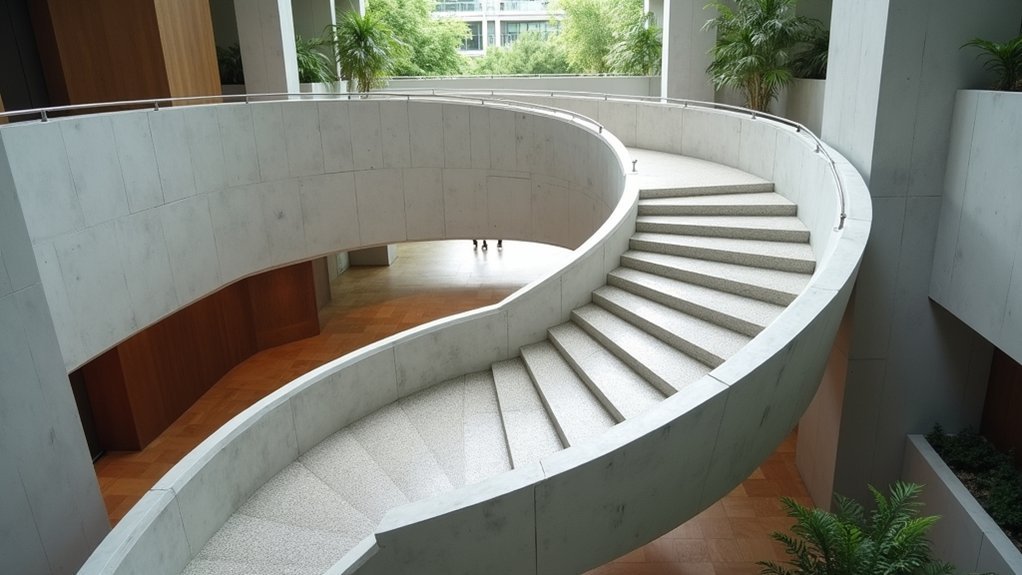
Three-dimensional printing technology transforms staircase construction by enabling complex geometries and artistic multi-level access systems that traditional methods simply can’t achieve. You’ll reduce production time considerably while creating customized designs that enhance your building’s aesthetic appeal without compromising structural integrity.
| Benefit | Traditional Method | 3D Printed Method |
|---|---|---|
| Cost Reduction | Standard pricing | Up to 30% savings |
| Design Flexibility | Limited geometries | Complex artistic forms |
| Production Time | Extended timelines | Considerably faster |
| Smart Integration | Retrofit required | Built-in sensors/lighting |
Your 3D printed concrete structures can integrate smart technology directly into precast stair designs, incorporating lighting systems and sensors seamlessly. You’ll eliminate material waste and reduce labor needs while achieving unique staircases that serve as functional art pieces in your construction projects.
Columns and Vertical Support Structures
You can create columns with intricate geometric patterns and hollow sections that weren’t possible with traditional casting methods, opening up new architectural possibilities while maintaining structural integrity.
These 3D printed vertical supports handle significant load-bearing requirements, with the ability to integrate complex internal geometries that distribute forces more efficiently throughout the structure.
You’ll find that the technology lets you produce single-piece columns up to 12.5 meters tall, eliminating weak joints while incorporating features like embedded conduits for utilities during the printing process.
Complex Geometric Designs
Although traditional construction methods have long constrained architects to simple geometric forms, 3D printing technology now enables you to create columns and vertical support structures with intricate, complex designs that were previously impossible or prohibitively expensive to build.
You can now produce 3D printed columns featuring twisted profiles, lattice frameworks, and organic curves that optimize load distribution while enhancing aesthetic appeal. These complex geometries aren’t just visually striking—they’re engineered for superior structural performance.
You’ll achieve 3x faster construction speeds compared to conventional techniques while reducing project costs by up to 30%. The precision of 3D printing allows you to integrate smart wall technologies directly into vertical supports, creating multifunctional elements that combine structural integrity with advanced building systems for truly innovative architectural solutions.
Load-Bearing Structural Capabilities
When it comes to load-bearing applications, 3D printed concrete columns stand up to the most demanding structural requirements in modern construction.
You can achieve compressive strengths exceeding 100 MPa by incorporating specialized admixtures into your concrete mix, making these load-bearing structures suitable for multi-story buildings and large-scale projects.
You’ll discover that 3D printing enables complex geometries impossible with traditional casting methods, enhancing both structural performance and visual appeal.
Your construction costs can drop by up to 30% when using 3D printed formwork, while reducing material waste considerably.
Precast Concrete Slabs and Flooring
Three revolutionary advantages define 3D printed precast concrete slabs and flooring systems in modern construction.
You’ll achieve unprecedented design precision, creating complex shapes and intricate geometries that traditional methods can’t replicate.
3D printing technology accelerates your production timeline dramatically, manufacturing precast concrete components three times faster than conventional techniques.
You’ll reduce costs by up to 30% through efficient digital craftsmanship and minimal material waste.
The technology enables rapid formwork creation, letting you customize designs for specific architectural requirements.
Rapid formwork creation through 3D printing technology allows complete design customization to meet unique architectural specifications and project requirements.
You can integrate smart technologies directly into your slabs, embedding sensors for real-time structural monitoring and building performance tracking.
This manufacturing approach transforms how you conceptualize flooring systems, offering flexibility, speed, and innovation that revolutionizes precast concrete construction processes.
Architectural Details and Ornamental Features
While traditional ornamental work demands months of skilled craftsmanship, 3D printed architectural details revolutionize how you’ll create custom cornices, moldings, and decorative facades.
You can now produce intricate balustrades and columns with complex geometries that traditional methods can’t achieve. The digital design process lets you create unique ornamental features at a fraction of typical costs and timeframes.
You’ll eliminate waste since 3D printing removes formwork requirements and tailors production to exact specifications. These custom components integrate seamlessly with smart building technologies, incorporating sensors directly into printed structures.
The rapid production speed accelerates your project timelines considerably, letting you complete buildings faster and adapt designs quickly based on client feedback. This technology transforms architectural details from expensive luxuries into accessible design elements.
Infrastructure Elements and Urban Furniture
Beyond decorative facades, 3D concrete printing transforms how you’ll design and produce essential urban furniture. You can create custom benches, tables, bus stops, and bike racks that perfectly complement public spaces while enhancing community aesthetics. This technology reduces production time and costs compared to traditional manufacturing methods.
With 3D printed infrastructure, you’ll achieve complex geometric shapes that offer unique style and functionality previously unfeasible with conventional construction techniques. You can produce large-scale public sculptures that contribute to urban art and culture, fostering community engagement and identity.
Most importantly, you can integrate smart technologies directly into printed components. Embedded lighting, sensors, and connectivity features enhance functionality, creating infrastructure that responds to modern urban needs while maintaining structural integrity and visual appeal.
Custom Beams and Lintel Systems
You can create beams and lintels with intricate geometries that traditional casting methods simply can’t achieve, opening up new possibilities for architectural expression.
These custom components handle significant structural loads while maintaining precise dimensional accuracy for your specific project requirements.
3D printing reduces your installation timeline dramatically, cutting beam production time by up to three times compared to conventional fabrication techniques.
Complex Geometric Designs
When architects envision sweeping curves, intricate lattice patterns, or geometrically complex structural elements, 3D printed concrete technology transforms these ambitious designs from concept to reality. You’ll discover that traditional construction methods simply can’t replicate the sophisticated shapes achievable through 3D printed formwork. These advanced capabilities enable you to create beams and lintels with intricate internal voids, organic curves, and multi-directional load paths.
| Design Feature | Traditional Method | 3D Printing |
|---|---|---|
| Curved Elements | Limited/Expensive | Unlimited Complexity |
| Internal Geometries | Nearly Impossible | Easily Achievable |
| Custom Patterns | Requires Manual Labor | Automated Production |
| Design Changes | Costly Rework | Simple File Updates |
You’ll find that complex geometric shapes optimize material distribution while maintaining structural integrity, creating components that are both aesthetically striking and functionally superior.
Load-Bearing Capabilities
Structural engineers now harness 3D printing technology to revolutionize load-bearing beam and lintel production, achieving compressive strengths exceeding 100 MPa while reducing material consumption by up to 30%.
You’ll find that 3D printed concrete components offer superior load-bearing capabilities through optimized geometric designs that distribute forces more effectively than traditional straight beams.
Advanced software lets you create custom shapes tailored to specific structural requirements. You can integrate reinforcement materials directly within the printing process, enhancing mechanical properties and durability.
The technology eliminates formwork needs, cutting labor costs and construction time considerably. You’ll achieve precise on-site printing while maintaining structural integrity.
These innovations make 3D printed load-bearing elements viable for diverse applications, from residential lintels to commercial structural components.
Installation Time Reduction
Revolutionary 3D printing technology slashes installation time for custom beams and lintel systems by up to 50%, transforming construction schedules through precision manufacturing and streamlined assembly processes.
You’ll experience dramatic installation time reduction when using 3D printed formwork for complex structural components. The technology produces large-scale beams up to 12.5 meters in single prints, eliminating multiple-piece assemblies. You can integrate electrical and plumbing systems during printing, making components installation-ready immediately.
| Traditional Method | 3D Printed Method |
|---|---|
| Multiple fabrication steps | Single print process |
| Custom mold delays | Rapid shape production |
| Separate utility installation | Integrated systems |
The streamlined process reduces material waste while maintaining structural integrity. You’ll find that precision manufacturing eliminates field adjustments, and pre-integrated utilities mean faster project completion without compromising quality or safety standards.
Frequently Asked Questions
Is It Possible to 3D Print Concrete?
Yes, you can 3D print concrete using layered extrusion techniques. You’ll achieve complex designs impossible with traditional methods while cutting costs by 50% and eliminating formwork needs for efficient construction.
What Materials Are Used in 3D Printing Concrete?
You’ll use cementitious materials including various cement types, aggregates, and admixtures. You’ll add superplasticizers and fibers to enhance workability and reduce cracking while achieving the precise balance between stiffness and extrudability.
What Equipment Is Needed for a 3D Printed Concrete Pour?
You’ll need a concrete 3D printer with heavy-duty motors, steel gantry system, cement feeding silo, concrete pumps, and mixers to execute your pour with proper material flow and structural integrity.
Is 3D Printed Concrete Expensive?
You’ll find 3D printed concrete isn’t expensive long-term. While initial printer costs reach $570,000, you’ll save up to 30% overall through reduced labor, eliminated formwork, and faster construction timelines.

Leave a Reply